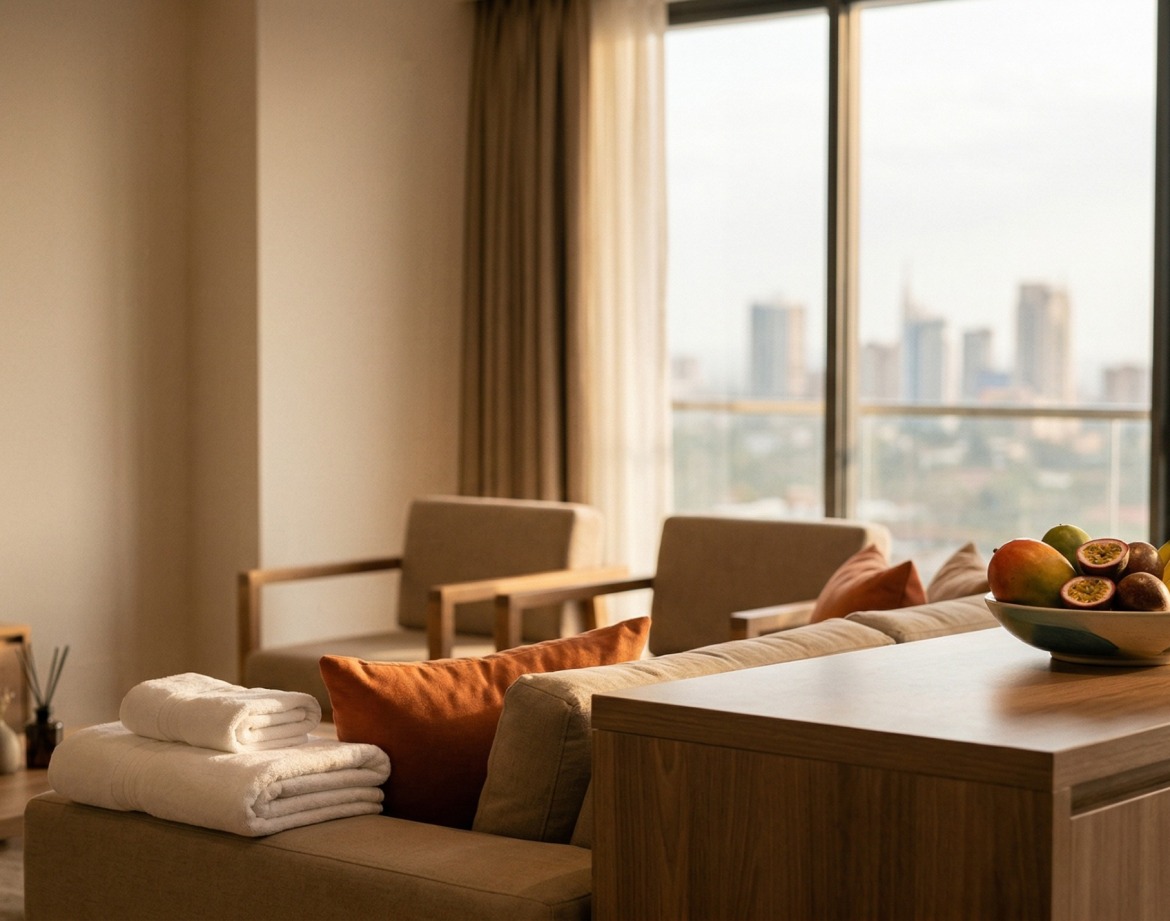
Airbnb Hosting in Kenya: The Complete Guide to Earning From Your Property in 2026
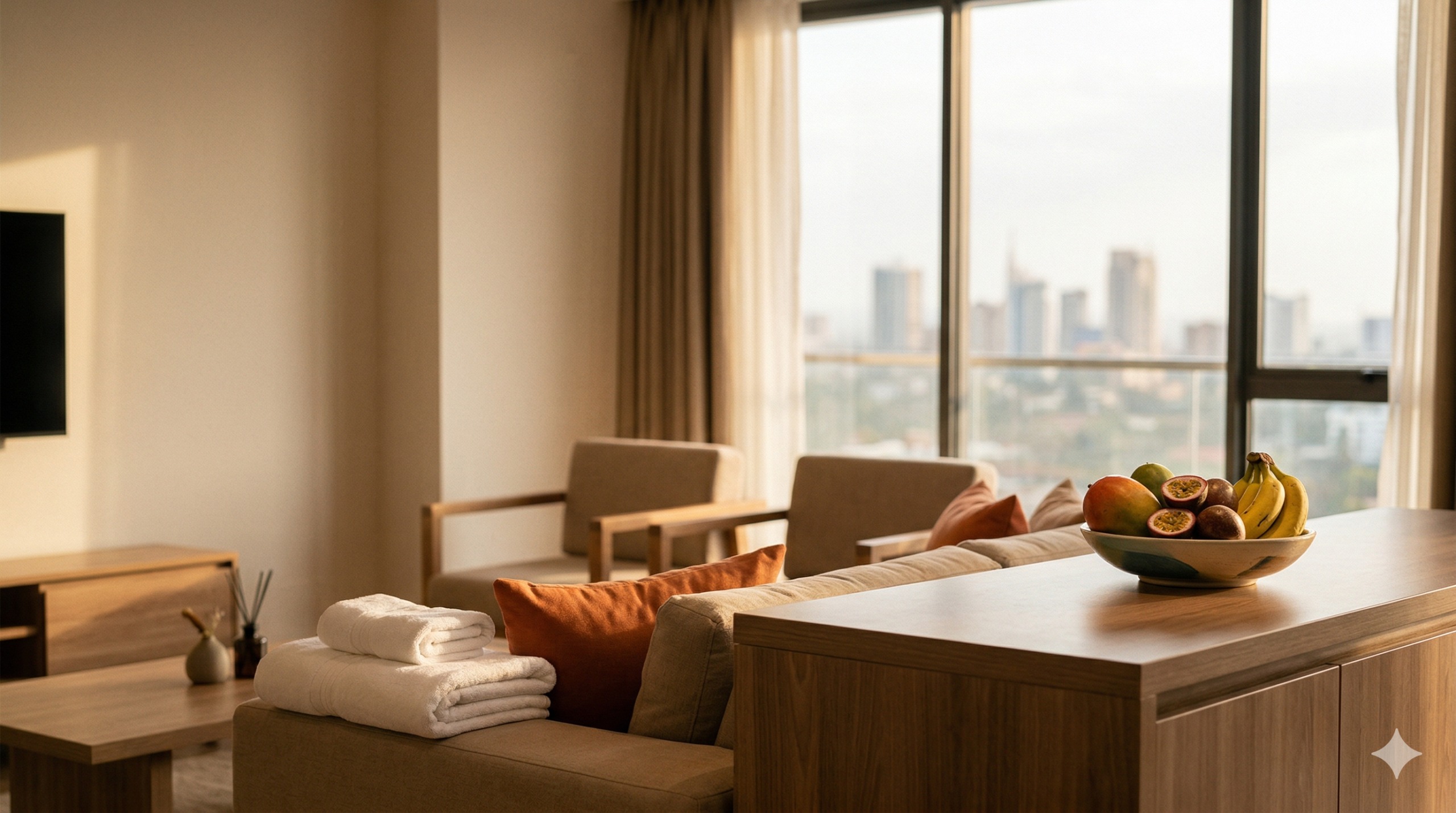
Airbnb hosting in Kenya has grown into a real income stream for hundreds of property owners — and the opportunity is bigger now than it has ever been. Nairobi attracts a steady stream of business travellers, diaspora visitors, UN professionals, and international tourists who all want something better than a hotel. They want a home. If you own an apartment, a cottage, or even a spare room, you are sitting on an asset that can pay you every single month.
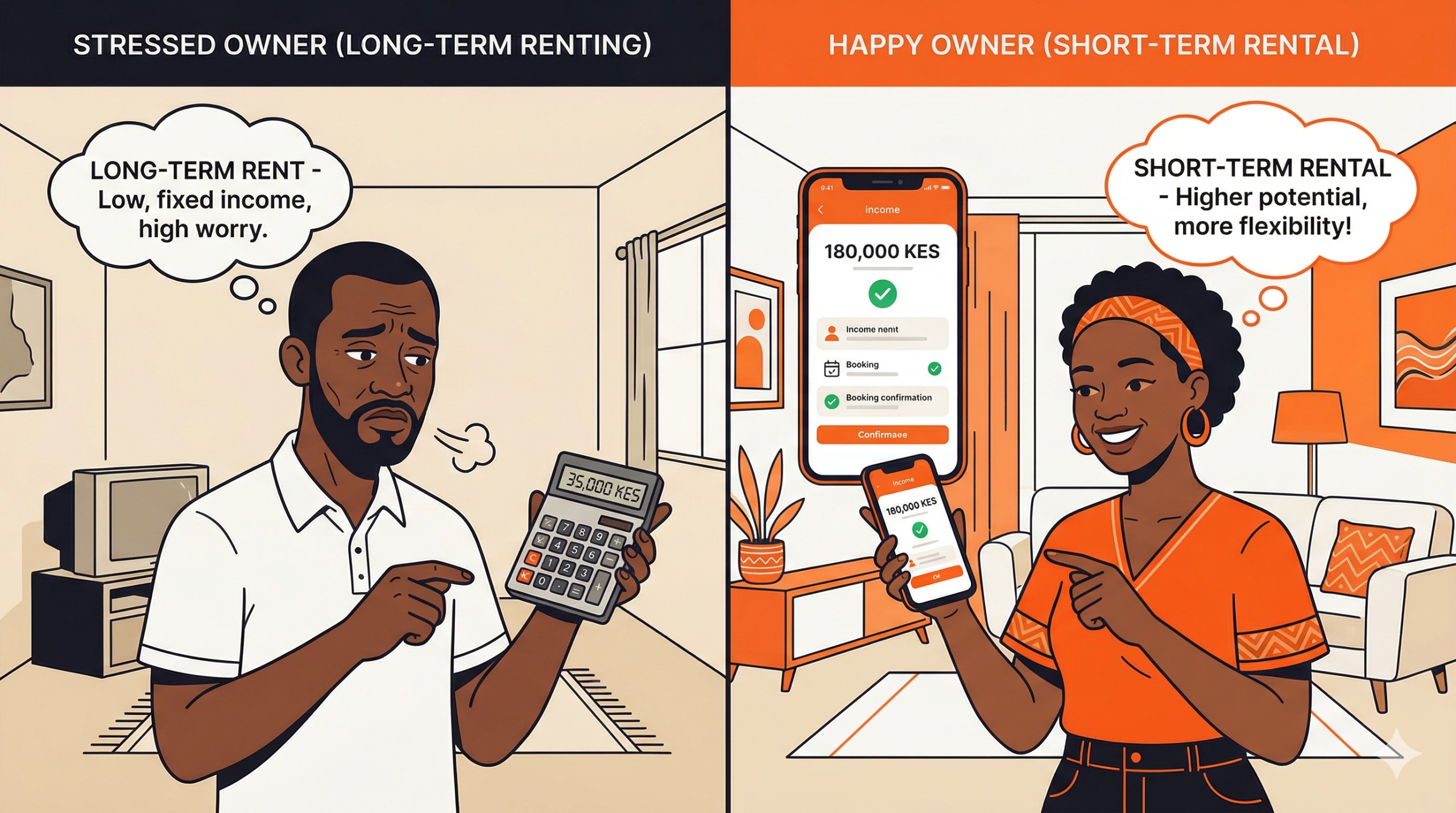
Yet most Kenyan landlords still hand their properties to long-term tenants at fixed rents — and leave serious money on the table. A one-bedroom apartment in Westlands that earns KES 35,000 per month on a long-term lease can generate KES 70,000 to KES 120,000 per month on the short-term market when it is managed well. That gap in the Airbnb hosting Kenya market is exactly where Trubay Stayz operates.
This guide covers everything — how the model works, what it costs to get started, what Kenya’s regulations say, how to price your space, and how to decide whether doing it yourself or partnering with a management platform is the right move for you.
How Airbnb Hosting in Kenya Actually Works
The short-term rental model is straightforward: guests book your property for a night, a week, or a month through an online platform, they pay upfront, and you earn per stay instead of per month. The big platforms operating in Kenya include Airbnb, Booking.com, and increasingly, locally-built alternatives like Trubay Stayz that understand the M-Pesa payment ecosystem and the Kenyan guest.
The booking flow
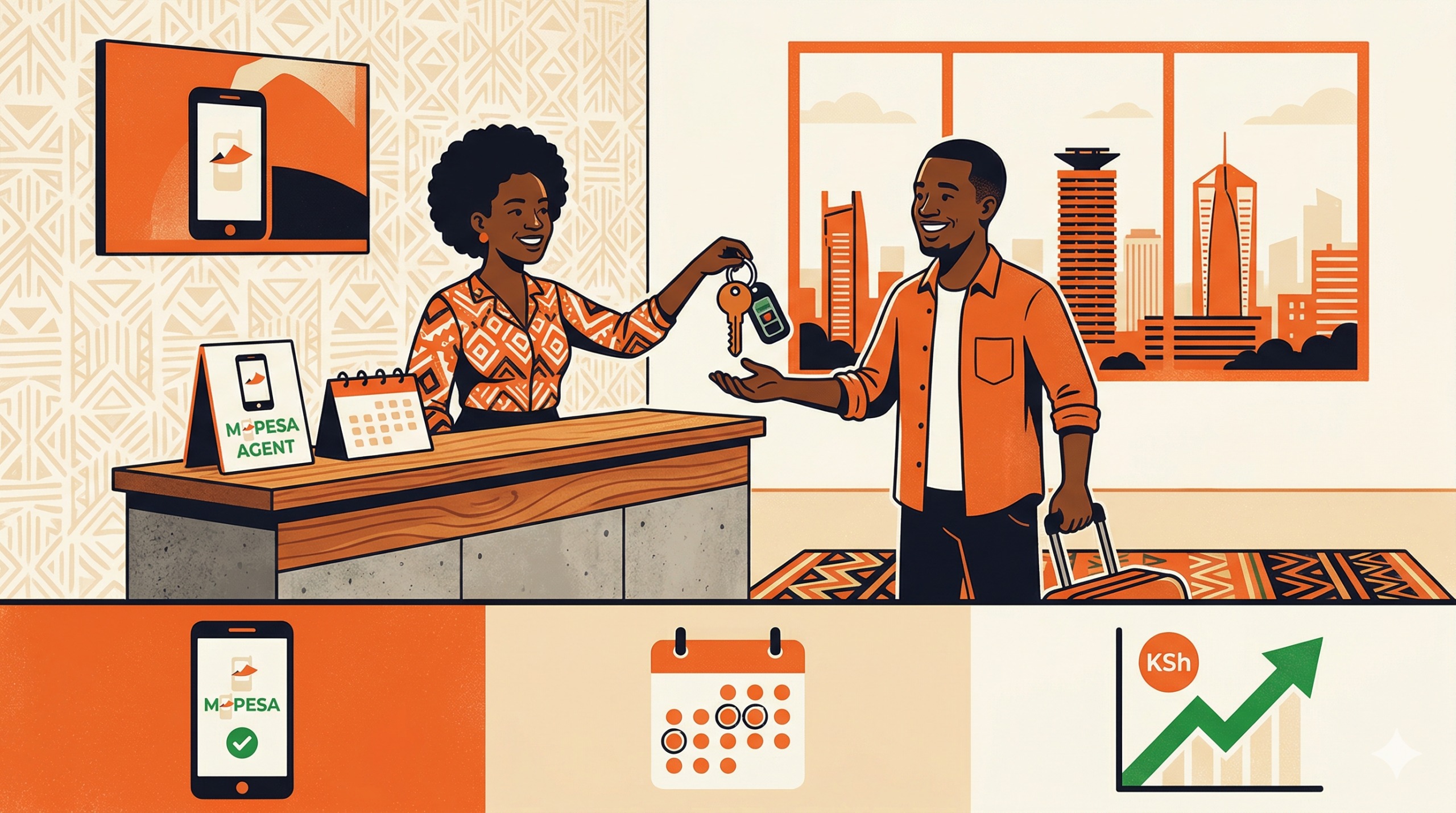
A guest searches for accommodation in, say, Kilimani or Westlands. Your property appears in the results. They book, pay online, and arrive at your door. You earn the nightly rate minus the platform’s commission — typically 3% on Airbnb for hosts, though this varies by listing type. On Trubay Stayz, host payouts come via M-Pesa within 24 hours of a completed stay.
What guests in Kenya actually want
Kenya’s short-term rental guest is not one person. The market splits into several clear segments, each with different expectations:
- Business travellers: Want fast Wi-Fi, a desk, a reliable hot shower, and proximity to Upperhill, Westlands, or the CBD. Nightly budgets of KES 5,000 to KES 15,000.
- Diaspora and family visitors: Want space, a full kitchen, and a neighbourhood that feels safe. Stays of 1–4 weeks. Budgets of KES 4,000 to KES 10,000 per night.
- UN and NGO professionals: Based at Gigiri or UNEP. Want long monthly stays, full amenities, and verified properties. Budgets of KES 8,000 to KES 20,000 per night.
- Leisure travellers: Safari stopovers, Nairobi weekenders. Shorter stays, price-sensitive. Budgets of KES 2,500 to KES 6,000 per night.
Understanding which guests your property attracts will shape every decision you make — from furnishings to pricing to which platform to list on. We cover the full pricing strategy for Nairobi rentals in a separate guide if you want to go deep on that topic.
What It Costs to Set Up Your Property for Short-Term Rentals
Initial setup investment
The most common question new hosts ask is: how much do I need to spend before my first booking? The honest answer is: it depends on your property’s current state. However, most successful hosts in Nairobi spend between KES 80,000 and KES 350,000 to furnish and equip a one-bedroom apartment from scratch. Here is a realistic breakdown:
| Item | Budget Option (KES) | Mid-Range (KES) |
|---|---|---|
| Bed, mattress & bedding | 18,000 – 25,000 | 40,000 – 65,000 |
| Sofa & living room furniture | 20,000 – 35,000 | 50,000 – 90,000 |
| Kitchen appliances & utensils | 15,000 – 22,000 | 30,000 – 55,000 |
| Wi-Fi installation (Safaricom/Zuku) | 3,000 – 5,000 | 3,000 – 5,000 |
| TV & entertainment | 12,000 – 18,000 | 25,000 – 45,000 |
| Bathrooom supplies & consumables | 5,000 – 8,000 | 8,000 – 14,000 |
| Photography (professional) | 5,000 – 8,000 | 10,000 – 18,000 |
| Total estimate | 78,000 – 121,000 | 166,000 – 292,000 |
Many hosts recoup this investment within 3–5 months of consistent bookings. Our guide on short-term rental income in Kenya breaks down the realistic earnings timeline so you can model your own property.
Ongoing monthly costs
Once you are live, your key monthly expenses will be: cleaning between guests (KES 800 – KES 2,000 per turnover), Wi-Fi (KES 3,000 – KES 6,000), electricity and water (variable — budget KES 5,000 – KES 12,000 depending on occupancy), and restocking consumables like toiletries and cleaning supplies (KES 1,500 – KES 3,500 per month). If you use a property manager, their fee will typically be 15–25% of gross revenue, covered in full in our property management fees Kenya guide.
Ready to list your property?
Trubay Stayz handles everything from photography to guest management — and you receive M-Pesa payouts within 24 hours of every completed stay. List Your Property on Trubay Stayz →

Legal Requirements for Airbnb Hosting in Kenya
This is the section most hosts skip — and later regret. Hosting your property on Airbnb in Kenya is not illegal, but it does carry legal and tax obligations that you must meet. Here is what you need to know before your first booking.
KRA registration and tax
All short-term rental income in Kenya is taxable. The Kenya Revenue Authority (KRA) categorises rental income under the Monthly Rental Income (MRI) tax regime for gross annual rental income between KES 288,000 and KES 15,000,000. The MRI rate is a flat 10% of gross rental receipts — no deductions allowed under this regime. You must file monthly returns using the KRA iTax portal. Failure to comply carries penalties and interest. We break down the full tax picture in our short-term rental tax guide for Kenya.
County business permit and TRAB licensing
Depending on your county and property type, you may need a single business permit from the county government. In Nairobi, this is issued by Nairobi City County. Additionally, the Tourism Regulatory Authority of Kenya (TRAB) has begun bringing short-term rental operators under its licensing framework. Compliance requirements are still evolving — check the current status on the KRA and county government websites, or ask Trubay Stayz for guidance when you sign up.
Building and landlord considerations
If you rent your apartment from a landlord, review your tenancy agreement carefully. Many agreements prohibit subletting without permission. Always get written consent before listing. If you own the property outright or have a mortgage, check with your bank — some mortgage agreements restrict commercial use.
⚠ Important
Operating as an unregistered short-term rental host in Kenya carries real risks: unpaid tax liabilities, county enforcement, and loss of platform privileges. Registering properly protects your income and your property.
How to Price Your Space for Maximum Earnings
Benchmarking against the market
Pricing a short-term rental correctly is a skill, not a guess. The Nairobi market has distinct tiers: budget properties in Ruiru or Kitengela average KES 2,000–KES 3,500 per night; mid-range units in Kilimani, Lavington, and Lang’ata range from KES 4,500 to KES 8,000; premium properties in Karen, Muthaiga, and Riverside Drive can command KES 10,000 to KES 25,000 per night. Westlands, as the prime business district, sits comfortably at KES 5,000 to KES 15,000 depending on specification.
Dynamic pricing principles
A flat rate is the fastest way to leave money on the table. Strong hosts adjust their prices based on: day of the week (weekdays command premiums from business travellers), season (December–January and July–August see spikes from diaspora and leisure travel), local events (Safari Rally, international conferences, CHOGM-style summits), and competitor availability. You can do this manually or use Airbnb’s Smart Pricing — though many experienced hosts override the algorithm, which tends to underprice in high-demand African markets.
The minimum night rule
Setting a 2–3 night minimum significantly improves your profitability. Single-night stays generate the most cleaning costs relative to revenue. Most experienced Nairobi hosts run 2-night minimums on weekdays and 3-night minimums on weekends and peak periods.
Is Airbnb Hosting in Kenya Worth It in 2026?
Let us be direct: yes, for the right property in the right location, managed well. But it is not passive income. It requires active management, attention to guest experience, and a real commitment to compliance. Here is a realistic comparison for a one-bedroom apartment in a mid-market Nairobi neighbourhood:
| Scenario | Monthly Gross (KES) | Monthly Net (KES) |
|---|---|---|
| Long-term tenant (fixed rent) | 32,000 | 28,000 – 30,000 |
| Self-managed short-term rental (60% occupancy) | 72,000 | 45,000 – 52,000 |
| Managed short-term rental via platform (60% occupancy) | 72,000 | 38,000 – 48,000 |
| Managed short-term rental (80% occupancy, optimised pricing) | 96,000 | 52,000 – 68,000 |
The numbers speak clearly. Even after management fees and expenses, a well-run short-term rental in Nairobi comfortably outearns long-term tenancy — and you retain flexibility to use your own property whenever you want.
When short-term rentals do not make sense
Short-term rentals are less suitable if: your property is in a location with very low tourist or business travel demand; your building management company or landlord prohibits it; you cannot handle the variable income month to month; or you are unwilling to invest in furnishing and presentation. In those cases, long-term rental remains a solid and lower-effort choice.
Trubay Stayz vs. Airbnb: What Is the Difference for Kenyan Hosts?
Airbnb is the world’s largest short-term rental platform — and that reach is genuinely valuable. But it was built for a global audience, and that creates real friction for Kenyan hosts. Support is difficult to reach in Kenyan time zones. Payouts come in USD and convert at bank rates. Guest communication happens through a closed messaging system with no phone option. And Airbnb’s search algorithm often disadvantages new listings, making it hard to get early traction.
Trubay Stayz was built specifically for the Kenyan market. As an Airbnb hosting Kenya provider, we offer: M-Pesa payouts within 24 hours, Kenyan-language support, host onboarding in person where needed, and local marketing on channels Kenyan guests actually use — WhatsApp, Instagram, and direct search. We are not a replacement for Airbnb. We are a complement — and for many hosts, the primary channel that drives the most reliable bookings.
List on Trubay Stayz alongside Airbnb
Most of our top-earning hosts are listed on both platforms. Trubay Stayz drives local and East African bookings while Airbnb brings international guests. Together, the occupancy rates are exceptional. Sign Up as a Trubay Stayz Host →
Your Next Step: Getting Started This Week
Starting Airbnb hosting in Kenya does not require perfection — it requires a start. Here is the minimum viable path to your first booking:
- Confirm your legal position: Check your tenancy or mortgage agreement. Register with KRA if you have not already done so.
- Prepare your space: Clean thoroughly. Invest in bedding, towels, and reliable Wi-Fi above all else — these are the things guests mention first in reviews.
- Take great photos: A KES 8,000 professional photography session pays for itself within the first week of bookings. Natural light, wide angles, clean staging.
- Set a competitive opening price: Start 15–20% below your target rate to build reviews fast, then raise prices as your rating climbs.
- Choose your platforms: List on Airbnb for international reach and on Trubay Stayz for local and East African bookings. The two audiences barely overlap.
If you would rather skip the setup headache entirely, sign up with Trubay Stayz, and our team handles photography, listing creation, pricing, and guest management on your behalf — from day one.
For deeper reading, explore our complete series: how much you can realistically earn, how to price your Nairobi listing, and how to handle your KRA tax obligations.
📱 Join Our Host WhatsApp Channel
Get weekly pricing tips, occupancy updates, and Nairobi rental market news directly on WhatsApp. Join the Trubay Stayz Host Channel →
Oscar Murimi — Short-Term Rental Specialist, Trubay Stayz. Oscar manages short-term rental operations across Kenya and advises property owners on maximising rental yield through the Trubay Stayz platform.
To start Airbnb hosting in Kenya, first check that your tenancy or ownership agreement allows short-term letting. Then register with KRA for rental income tax, furnish and photograph your property, and create listings on Airbnb and Trubay Stayz. Most hosts complete setup within 2–3 weeks and receive their first booking within days of going live on both platforms.
Earnings depend on your property’s location, quality, and occupancy rate. A one-bedroom apartment in mid-Nairobi (Kilimani, Westlands, Lavington) typically earns KES 60,000 to KES 110,000 gross per month at 60–80% occupancy. After expenses and management fees, net income usually exceeds long-term rental yield by 60–120%. Premium properties in Karen or Riverside Drive can earn significantly more.
Yes. You need a county business permit from your local county government (e.g., Nairobi City County), KRA registration for rental income tax under the Monthly Rental Income regime, and increasingly, compliance with Kenya’s Tourism Regulatory Authority (TRAB) licensing framework. Requirements are evolving — confirm current status with the relevant county authority or with Trubay Stayz when you sign up.
Yes — through Trubay Stayz, host payouts are made via M-Pesa within 48 hours of a completed guest stay. Airbnb pays in USD via bank transfer, which can take 3–5 business days and incurs currency conversion costs. For Kenyan hosts who prefer local mobile money payouts, Trubay Stayz is the more practical option for domestic income management.
Airbnb offers global reach and a large international audience. Trubay Stayz is built for the Kenyan market — with M-Pesa payouts, Kenyan guest verification, local marketing, and in-person host support. Most successful Nairobi hosts list on both platforms: Airbnb for international guests and Trubay Stayz for local and East African bookings.
In most Nairobi locations, yes — significantly. A property earning KES 32,000 per month on a long-term lease can earn KES 72,000 to KES 96,000 gross on the short-term market at 60–80% occupancy. After management fees and operating costs, net short-term income typically exceeds long-term rental income by 50–100% or more, depending on the property and its location.