


Property Management Fees Kenya: Complete Guide for Property Owners


By Oscar Murimi · Short-Term Rental Specialist, Trubay Stayz
Updated: March 2026⏱ 9 min read
Property management fees in Kenya typically range from 5% to 15% of monthly rent for long-term rental properties, and 15% to 30% of booking revenue for short-term rental management. The exact rate depends on the level of service, the property location, and whether the manager provides full management or rent collection only. In Nairobi’s prime areas, standard full-service management costs 10–15% of monthly rent.
Table of Contents
- Why do property management fees in Kenya vary so widely
- The full rate breakdown — long-term and short-term
- What your management fee should actually cover
- Hidden fees that quietly reduce your net income
- How to verify a property manager before you hire
- DIY property management — when it makes sense
- Short-term rental management — a different calculation
Property management fees in Kenya vary more widely than most property owners expect — and not always for reasons that are obvious upfront. Two managers in the same Nairobi neighbourhood may quote 8% and 15% respectively for what appears to be the same service. The difference rarely reflects the quality of work. More often, it reflects what each manager chooses to include in their stated fee and what they quietly bill for separately. Understanding this distinction — before you sign a management agreement — is what separates property owners who protect their net income from those who gradually lose it.
This guide gives you the complete picture: standard rates, what those rates should include, the hidden charges that appear in most Kenyan management contracts, how to verify a manager before committing, and when managing your own property — or listing on a local platform like Trubay Stayz — makes more financial sense than hiring a traditional manager.
Why Property Management Fees in Kenya Vary So Widely
The Kenyan property management market is largely unregulated in practice, despite the existence of the Estate Agents Registration Board (EARB). Many managers operate without formal registration, quote fees informally, and structure contracts in ways that are difficult to compare directly. Additionally, the scope of services bundled into a stated management fee differs significantly between providers — making headline percentages an unreliable basis for comparison.
Three factors most directly explain why two managers charge different rates for similar properties. First, the service scope — a manager charging 15% who handles tenant screening, maintenance, legal disputes, and monthly reporting is delivering more value than one charging 12% for rent collection alone. Second, the property location — prime Nairobi neighbourhoods like Westlands, Karen, and Kilimani attract higher management fees partly because the properties command higher rents and partly because the tenant expectations in those areas require more active management. Third, the manager’s own cost structure — registered firms with offices, staff, and insurance carry higher overhead than individual operators working informally.
The most important thing to understand is this: the management fee percentage is not the number that determines your net income — the total cost of management is. A manager charging 10% with a KES 15,000 setup fee, a maintenance markup of 15%, and a one-month vacancy fee costs significantly more than a manager charging 13% with none of those additions. Always calculate the full annual cost, not just the headline rate.
Property Management Fees in Kenya: The Full Rate Breakdown
The following rates reflect the current Kenyan market in 2026. They are structured by service level and property type — because the right comparison is not manager against manager, but service level against service level.
| Service Level | What Is Included | Typical Fee | Best For |
|---|---|---|---|
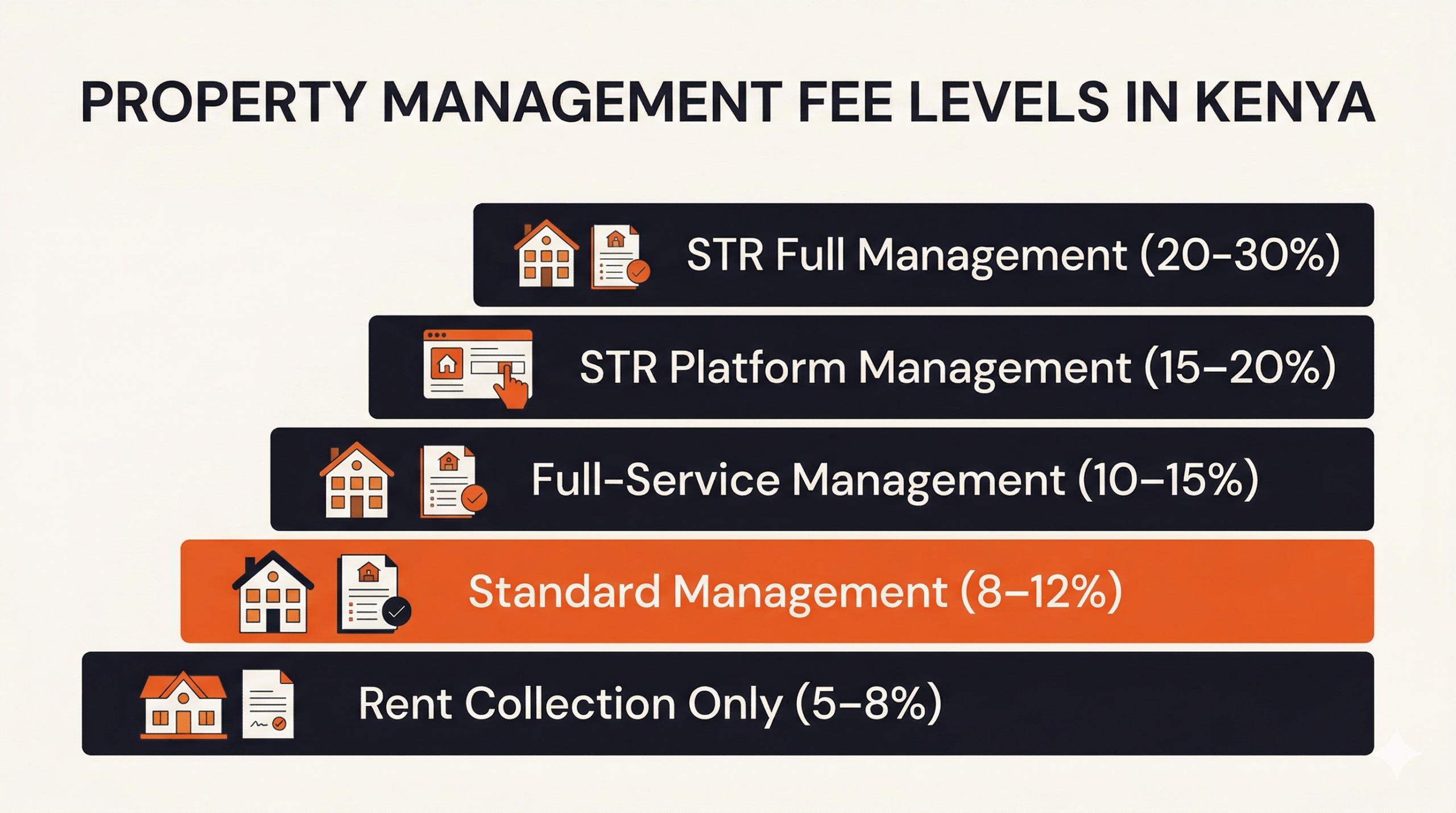
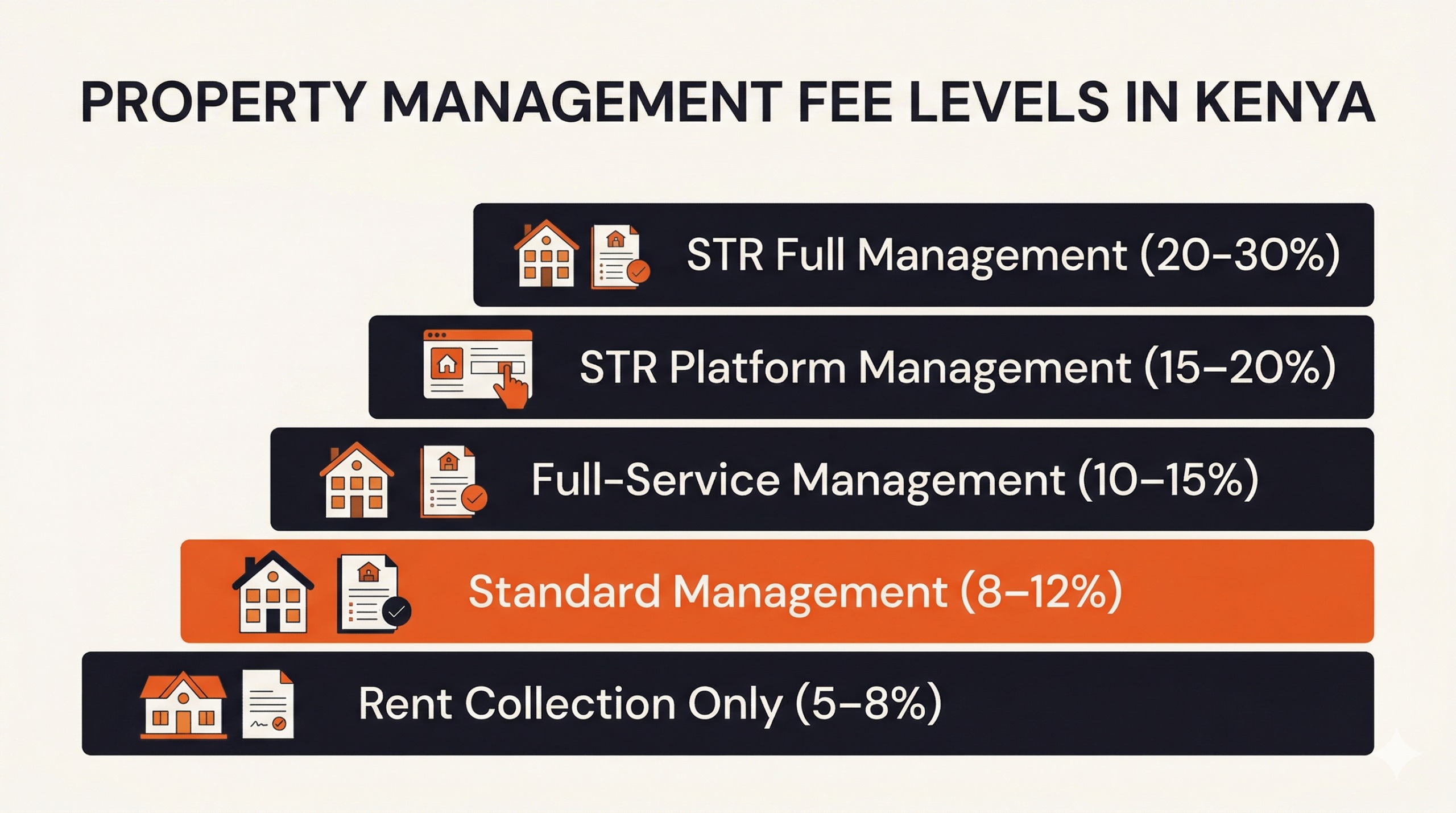
| Rent Collection Only | Collecting monthly rent via M-Pesa or bank, remitting to owner, basic arrears follow-up | 5–8% of monthly rent | Owners with existing tenants who simply want collection handled |
| Standard Management | All of the above + tenant screening, maintenance coordination, monthly reporting, routine inspections | 8–12% of monthly rent | Most Kenyan landlords — the typical working arrangement |
| Full-Service Management | All of the above + tenant sourcing, legal support, utility management, insurance liaison, annual property review | 10–15% of monthly rent | Diaspora owners or multi-property investors wanting fully hands-off management |
| STR Platform Management | Guest communications, check-in/out, cleaning coordination, pricing, listing management, reviews | 15–20% of booking revenue | Short-term rental hosts using a platform-based manager or co-host |
| STR Full Management | All STR platform services above + maintenance, emergency response, pricing strategy, multi-platform listing | 20–30% of booking revenue | Collecting monthly rent via M-Pesa or bank, remitting to the owner, and basic arrears follow-up |
For long-term rental properties in Nairobi, the most common arrangement falls in the 8–12% range. Looking at properties in secondary areas — Ruaka, Thika Road, Rongai, Kahawa West — rates tend toward the lower end of that range because rents are lower and competition among managers is stronger. For short-term rental properties, the rates above are for the management service itself — before Airbnb or other platform fees are added on top.
What Your Management Fee Should Actually Cover
A common mistake Kenyan property owners make is assuming that a management fee covers everything management-related. It rarely does, but a good manager will be specific about what is and what is not included. Before signing any management agreement, confirm in writing that each of the following is explicitly addressed.
01
Tenant Screening
Reference checks, employment verification, and previous landlord contact. Good managers do this systematically. Poor ones accept whoever applies first. This is the single biggest determinant of how smoothly your tenancy runs.
02
Rent Collection & Remittance
Monthly rent collected, arrears followed up, and funds remitted to your account on a set date — ideally via M-Pesa or direct bank transfer with a clear payment confirmation. Confirm the remittance timeline: good managers pay within 5 business days of the rent date.
03
Maintenance Coordination
Receiving maintenance requests from tenants, sourcing contractors, overseeing work, and reporting costs to the owner. Confirm whether the manager marks up contractor invoices — this is a common source of hidden cost that we cover in Section 4.
04
Monthly Reporting
A written statement every month showing income received, expenses incurred, and net remittance to the owner. Any manager who resists providing monthly reports is a manager you should not hire. Transparency is not optional.
05
Routine Inspections
Periodic property inspections — at minimum annually, ideally at each tenancy change — to document the property’s condition and identify maintenance issues before they become expensive. Confirm these are included and that you receive a written inspection report.
06
KRA Compliance
For diaspora owners especially, the manager should understand Kenya’s rental income tax obligations and ideally assist with or at minimum not obstruct KRA MRI compliance. Some managers assist with tax remittance — clarify this upfront. See our complete short-term rental tax guide for what is required.
For short-term rental properties specifically, Trubay Stayz provides management-equivalent service as part of the platform — no separate manager needed, M-Pesa payouts, and a local Nairobi team. See How Trubay Stayz Works →
Hidden Property Management Fees in Kenya to Watch For
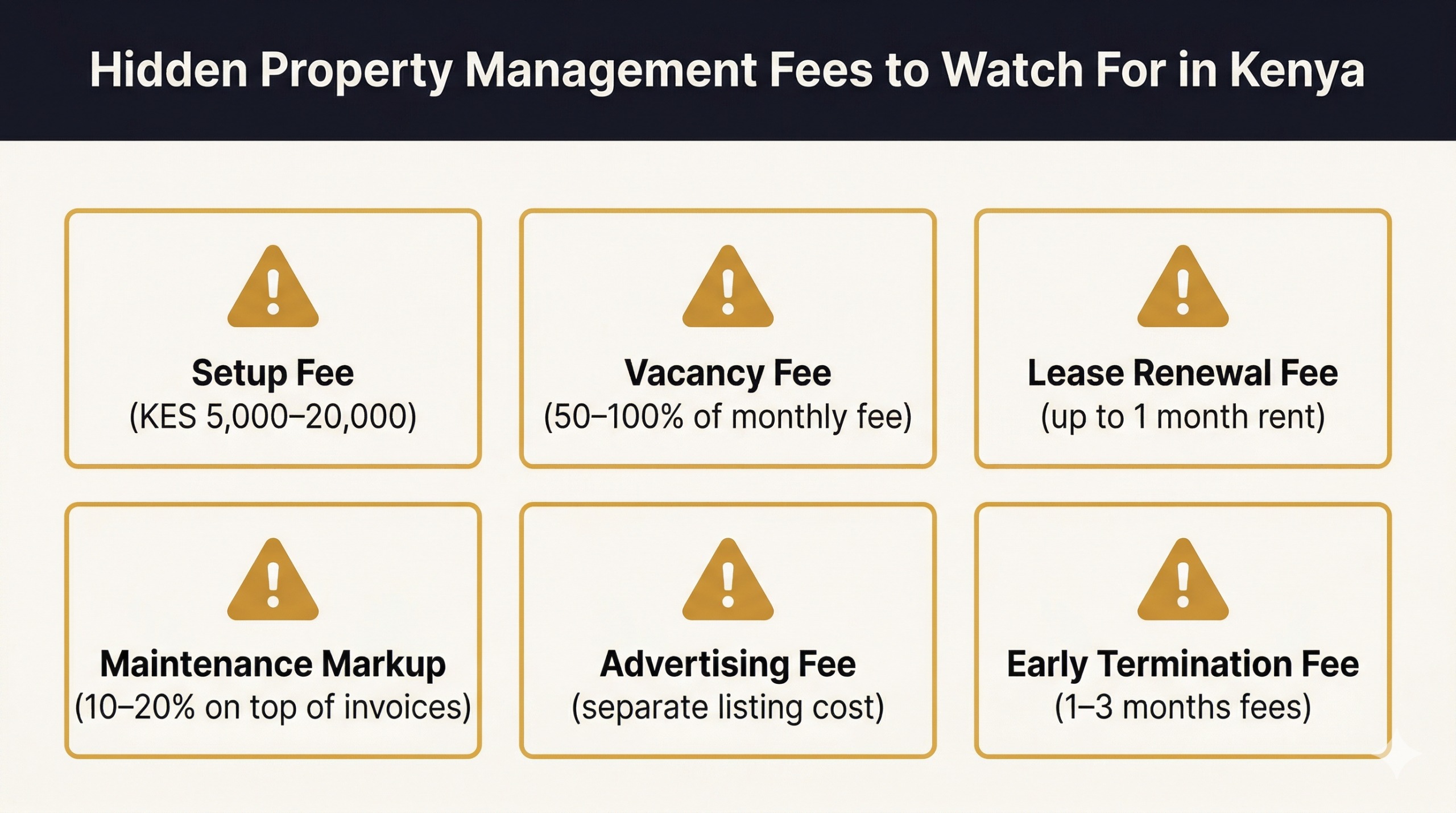
Understanding property management fees in Kenya requires looking beyond the headline percentage. Several additional charges appear regularly in Kenyan management contracts — sometimes disclosed upfront, sometimes buried in the fine print. Each of the following warrants a direct question before you sign.
- Setup fee: A one-time fee charged at the start of the management relationship. Typically KES 5,000–20,000. Some managers include this in the first month’s management fee — others charge it separately. Always ask.
- Vacancy fee: Some managers charge a percentage of the management fee — or even the full fee — during months when the property is empty, and no rent is collected. This is a hidden cost during tenant transitions. Negotiate this to zero or to a maximum of one month before signing.
- Lease renewal fee: A charge when an existing tenant renews their lease — sometimes one month’s rent, sometimes a flat fee. This is often described as a “tenant retention fee” in contracts. It should not be higher than half a month’s rent for a standard renewal.
- Maintenance markup: The most common and most underappreciated hidden cost. Many managers add 10–20% on top of every contractor invoice as a “coordination fee.” On a KES 40,000 plumbing repair, that is KES 4,000–8,000 added to your bill. Ask directly: Does the manager mark up contractor costs? Request that all maintenance invoices be shared with you.
- Advertising or listing fee: Some managers charge a separate fee to advertise a vacant property. This should be included in the management fee — if it is not, the manager has a financial incentive to let vacancies persist longer than necessary.
- Early termination fee: If you end the management agreement before a specified term, some contracts impose a fee of one to three months’ management fees. This clause can trap property owners in poor management relationships. Negotiate a maximum 30-day notice period without penalty.
💡 Negotiation Note
Every item above is negotiable before signing. A manager who refuses to negotiate on hidden fees or who cannot clearly explain why a charge is necessary is giving you important information about how transparent the relationship will be. The time to resolve ambiguity is before the contract is signed, not after your first management statement arrives.
How to Verify a Property Manager Before You Hire
Kenya’s property management market includes both excellent operators and deeply unreliable ones — and the two are not always easy to distinguish from a first conversation. These verification steps take less than an hour and substantially reduce your risk.
Check EARB Registration
Property managers in Kenya are required to register with the Estate Agents Registration Board (EARB). Ask the manager for their EARB registration number and verify it on the EARB website. Many informal operators lack this registration — not necessarily because they are dishonest, but because their lack of formal structure is a genuine risk to the quality and accountability of their service.
Ask for References from Current Clients
Request contact details for two or three property owners they currently manage for, and actually call them. Ask specifically: Do they pay on time? Do they communicate clearly? Have there been any billing surprises? A manager confident in their work will provide references without hesitation. One who stalls or deflects is communicating something important.
Review Their Management Agreement in Detail
Before signing, go through the management agreement line by line. Look specifically for: the defined scope of services, all fee structures and additional charges, the notice period for termination, maintenance authorisation limits, and how disputes are handled. If the agreement is vague or missing key provisions, ask for additions in writing before proceeding.
Test Their Responsiveness
Message and call the prospective manager at different times of day before committing. How quickly they respond to a prospective client tells you a great deal about how they will respond to your tenants and to maintenance emergencies once the contract is signed. A manager who takes 48 hours to reply to an initial enquiry will not suddenly become responsive once they have your business.
Curious what your property could earn from short-stay guests before deciding whether long-term management or short-term rental is the better route? Read the Kenya Earnings Guide →
DIY Property Management — When It Makes Sense
Not every property owner needs a property manager. For owners with one or two properties in the same city where they live, managing directly is entirely viable — and saves the entire management fee. The relevant question is not “should I hire a manager?” but rather “what is an hour of my time worth, and how many hours per month does managing this property actually take?”
A single well-tenanted property in Nairobi, with a reliable tenant and a good maintenance contractor on call, requires roughly two to four hours per month to manage effectively. At a management fee of 10% on a KES 45,000/month rent, you are paying KES 4,500 per month — or roughly KES 1,500 per hour of management work — for someone else to handle this. Many property owners conclude that this is entirely worthwhile. Others, particularly those with demanding full-time commitments, conclude it is the best KES 4,500 they spend each month.
Where DIY management becomes genuinely difficult is at scale. Managing three or more properties simultaneously — with different tenants, different maintenance schedules, and different lease renewal dates — becomes a significant time commitment that eventually justifies professional management regardless of the fee.
Short-Term Rental Management — A Different Calculation
For short-term rental properties, the management fee calculation is fundamentally different from long-term rental management. The operating environment is more demanding — guests check in and out regularly, communication happens daily, cleaning is more frequent, and pricing requires active management. Consequently, the fees are higher. However, the income potential is also significantly higher, as our guide to short-term rental income in Kenya shows in detail.
The critical factor for short-term rental management in Kenya is the platform through which you list. Managers who operate through Airbnb add their fee on top of Airbnb’s existing 17–20% combined platform fee. On a KES 5,000 per night booking, Airbnb takes approximately KES 850–1,000 in fees, and then the manager takes another 20–25% of the remaining amount. The combined cost to the property owner can reach 35–40% of gross booking revenue before the income lands in their account.
This is why listing through a local Kenyan platform like Trubay Stayz changes the calculation significantly. The management-equivalent service — guest communication, booking management, local host support — is built into the platform’s structure. Payouts are processed directly in Kenyan Shillings via M-Pesa, with no currency conversion losses. For property owners considering whether to hire a separate short-term rental manager, the total cost comparison between that arrangement and listing on a dedicated local platform is worth running carefully. The difference, calculated annually, is often substantial. For context on what these fees mean for co-hosting specifically, our Airbnb co-hosting guide covers the combined fee picture in full.
If your property is in Nairobi, Mombasa, Diani, Naivasha, or Nakuru, Trubay Stayz is the local alternative to both Airbnb and a separate short-term rental manager. List Your Property on Trubay Stayz →
Know Your Fees. Keep More of Your Income.
Join Kenyan property owners earning consistent short-term rental income on Trubay Stayz — with transparent local fees, M-Pesa payouts, and no hidden management charges.
Become a Host on Trubay Stayz →
Typical property management fees in Kenya range from 5–8% of monthly rent for basic rent collection, 8–12% for standard management including tenant screening and maintenance coordination, and 10–15% for full-service management covering legal support, inspections, and utility management. For short-term rental management, fees range from 15–20% for platform-based management to 20–30% for full management, including guest services and emergency response.
A standard property management fee in Kenya should include tenant screening, monthly rent collection and remittance, maintenance coordination, routine property inspections, and monthly reporting to the owner. Full-service management additionally covers tenant sourcing, legal support for disputes or evictions, utility management, and insurance liaison. Always confirm in writing exactly what is and is not included before signing a management agreement.
Yes. Common hidden fees in Kenyan property management contracts include a one-time setup fee (KES 5,000–20,000), vacancy fees charged during empty months, lease renewal fees of up to one month’s rent, maintenance markups of 10–20% on contractor invoices, separate advertising fees, and early termination penalties. Always request a full list of all charges before signing and negotiate any that are not clearly justified.
Yes. Property managers and estate agents in Kenya are required to register with the Estate Agents Registration Board (EARB). EARB registration provides a basic level of accountability and professional standing. Always ask for a manager’s EARB registration number and verify it on the EARB website before engaging their services. Many informal managers operate without registration, which increases the risk to property owners.
Self-managing a single well-tenanted property in Kenya can save the entire management fee — typically KES 3,000–8,000 per month, depending on the rent. However, self-management requires active involvement in tenant communication, maintenance coordination, rent collection, and compliance. For owners with one or two local properties and the time to manage them, it is financially advantageous. For diaspora owners or those with multiple properties or demanding schedules, professional management or a local platform like Trubay Stayz is generally the better option.
Short-term rental management fees in Kenya are higher than long-term management fees because the workload is significantly greater — guest communication is daily, check-ins are frequent, cleaning is required between every booking, and pricing must be actively managed. Fees range from 15% for platform-only management to 30% for full service. Additionally, if the manager operates through Airbnb, the Airbnb platform fee of 17–20% is charged on top of the management fee, creating a combined cost of 32–50% of booking revenue.
