
Airbnb Hosting in Kenya: The Complete Guide for Property Owners (2026)

By Oscar Murimi · Short-Term Rental Specialist, Trubay Stayz
Updated: March 2026⏱ 9 min read
📌 Quick Answer — Featured Snippet Target
Airbnb hosting in Kenya works by listing your furnished property on short-term rental platforms — Airbnb, Booking.com, and Trubay Stayz — where guests book and pay per night or per week. A one-bedroom apartment in Nairobi’s mid-market neighbourhoods (Kilimani, Westlands, Lavington) typically earns KES 60,000 to KES 110,000 gross per month at 60–80% occupancy — significantly more than the equivalent long-term lease. Set up requires a furnished property, KRA registration for rental income tax, professional photography, and competitive pricing. Most hosts receive their first booking within days of going live.
Table of Contents
- Why Kenyan property owners are switching to short-term rental
- How Airbnb hosting in Kenya works — the model explained
- What it costs to set up your property
- Legal and tax requirements every host must know
- How to price your listing for maximum earnings
- Is Airbnb hosting in Kenya worth it in 2026?
- Your next steps — getting your first booking this month
Airbnb hosting in Kenya has become one of the most reliable ways for property owners to significantly increase their rental income — without selling, refinancing, or taking on extra risk. Nairobi alone receives a consistent year-round flow of business travellers, UN and NGO professionals, diaspora visitors, and international tourists. All of them need a place to stay. Many of them prefer a furnished apartment over a hotel. And most landlords in Kenya are still leaving that demand completely unmet.
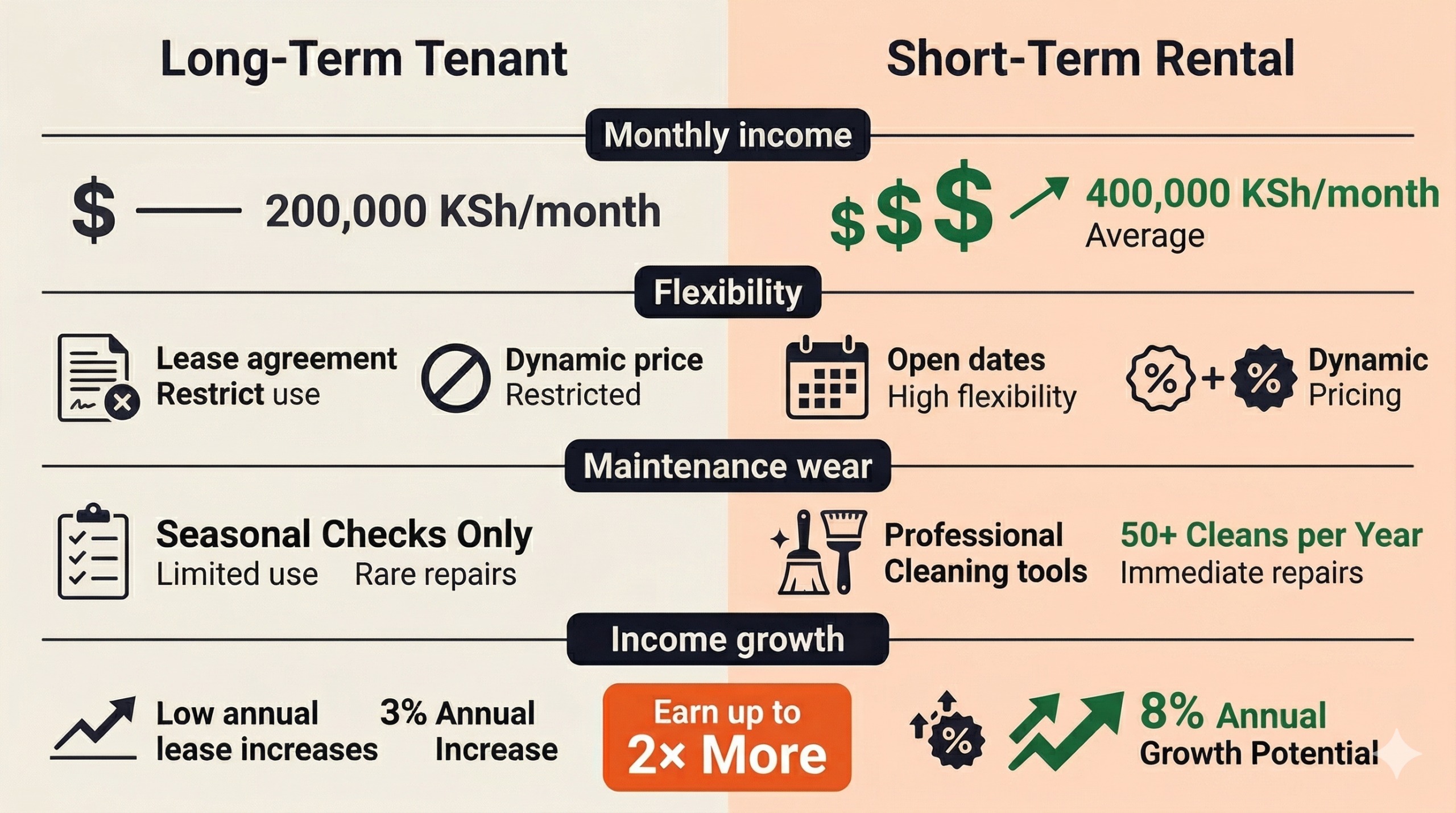
The typical long-term tenancy in Nairobi pays KES 25,000 to KES 45,000 per month for a one-bedroom apartment in a mid-market neighbourhood. The same property, professionally presented and managed as a short-term rental, can earn KES 70,000 to KES 120,000 gross in the same month. That gap — between what most landlords earn and what the market will actually pay — is precisely what this guide addresses.
This is the complete reference for Kenyan property owners considering the switch. It covers how the model works, the real setup costs in KES, Kenya’s tax and licensing requirements, how to price competitively, and what honest earnings look like at realistic occupancy rates.
Why Kenyan Property Owners Are Switching to Short-Term Rental
The long-term rental model has one clear advantage: predictability. A fixed monthly income, a signed agreement, and minimal interaction with tenants suits many landlords. However, predictability comes at a cost. Long-term rents in Kenya have not kept pace with inflation, property values, or the cost of maintaining a well-furnished apartment. Meanwhile, the short-term rental market — driven by Nairobi’s status as East Africa’s primary business hub — has continued to grow year-on-year.
Nairobi hosts the African Union, UNEP, UN-HABITAT, and the regional headquarters of hundreds of multinationals and international NGOs. The Safari Rally, major trade conferences, and the African tech ecosystem generate thousands of annual visitor nights that the hotel market struggles to absorb at competitive price points. Short-term rental fills that gap — and property owners who position themselves correctly are the primary beneficiaries.
The strongest argument for short-term rental is not the income — it is control. You can block dates for personal use, adjust your rates for peak seasons, and exit the model without a lengthy notice period. Long-term tenancy locks you in. Short-term rental keeps your options open while earning you more.
How Airbnb Hosting in Kenya Works — The Model Explained
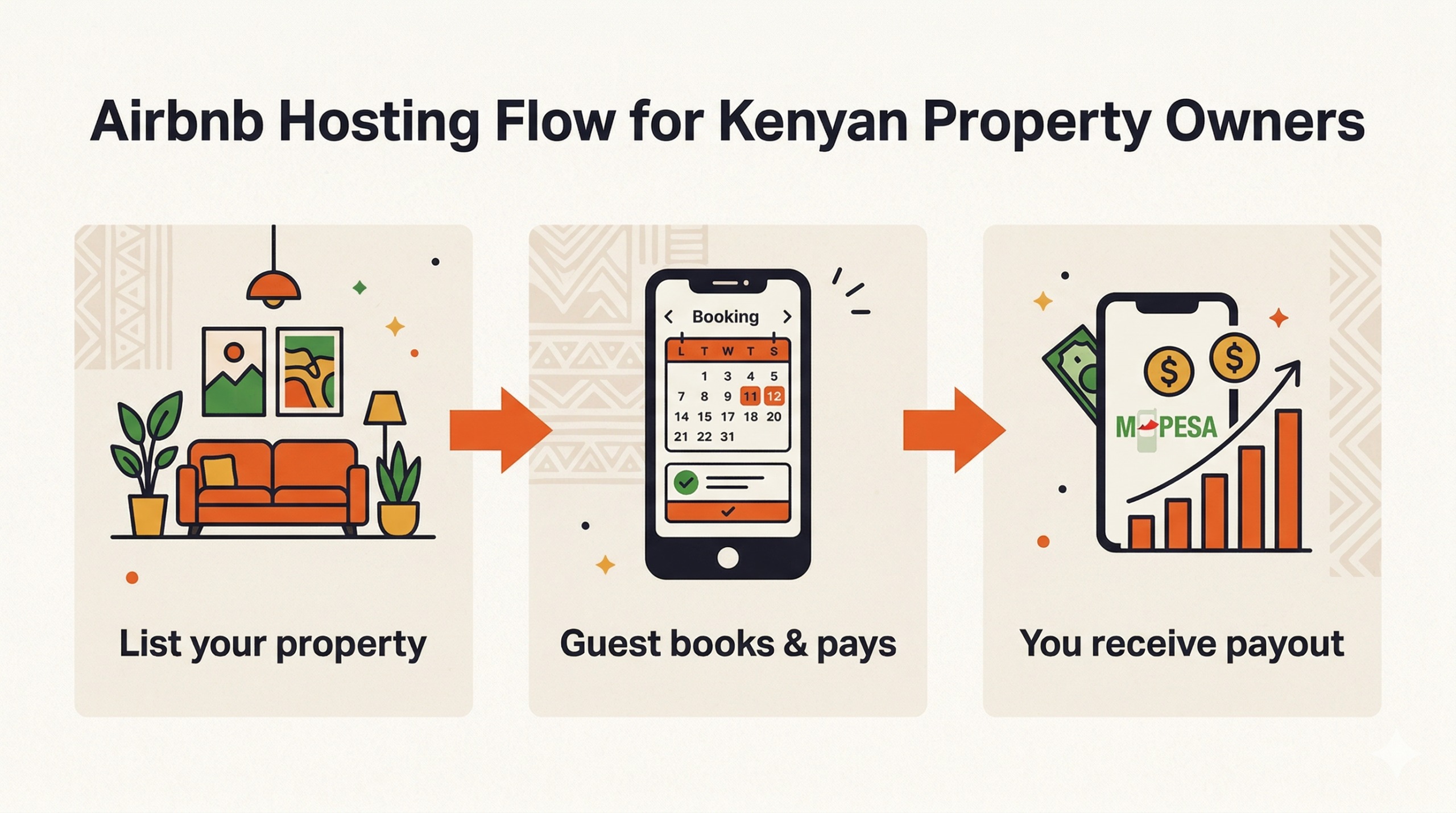
The short-term rental model is straightforward. You furnish your property to a guest-ready standard, create a listing on one or more platforms, set your nightly rate, and guests book directly. They pay upfront, stay for their confirmed dates, and leave. You receive the payout — minus the platform’s commission — after checkout.
The platforms operating in Kenya
Three platforms currently serve the Kenyan short-term rental market in a meaningful way. Airbnb has the largest international audience — it is where guests from Europe, North America, and the Gulf search first. Booking.com drives strong corporate and diplomatic traffic. Trubay Stayz is Kenya’s locally built platform, designed specifically for the East African market — with M-Pesa payment processing, Kenyan guest verification, and local host support. Most high-earning Nairobi hosts are listed on all three, with Trubay Stayz driving the most consistent domestic and regional bookings.
Who is booking in Kenya?
Understanding your guest segment shapes every decision you make — from furnishings to pricing to which platform matters most for your property type:
- Business travellers and consultants: The highest-value weekday segment. They book 5–14 nights, need reliable Wi-Fi and a dedicated workspace, and are less price-sensitive than leisure guests. Concentrated in Westlands, Upper Hill, Kilimani, and Gigiri. Nightly budgets of KES 5,000 to KES 15,000.
- UN and NGO professionals: Long-stay guests based near the Gigiri UN complex. Often book monthly or quarterly. They want fully equipped apartments, verified security, and a platform that accepts corporate purchase orders or card payments. Budgets of KES 8,000 to KES 20,000 per night.
- Diaspora and family visitors: Primarily December–January and July–August peaks. They want space, full kitchen facilities, and proximity to family in established Nairobi neighbourhoods. Stays of 1–4 weeks. Budgets of KES 4,000 to KES 10,000 per night.
- Leisure and weekend travellers: Safari stopovers, Nairobi weekenders, and regional visitors from Uganda, Tanzania, and Rwanda. Shorter stays, more price-sensitive. Budgets of KES 2,500 to KES 6,000 per night.
Knowing which segment your property’s location and specification attracts is the first step toward setting the right price. Our vacation rental pricing guide for Nairobi covers the full pricing methodology for each neighbourhood and guest type.
What It Costs to Set Up Your Property
The most common question new hosts ask is how much they need to spend before their first booking. The honest answer depends on your property’s current state. However, most successful hosts in Nairobi spend between KES 90,000 and KES 320,000 to furnish and equip a one-bedroom apartment from scratch. Here is a realistic cost breakdown for 2026:
| Setup Item | Budget Range (KES) | Mid-Range (KES) | Notes |
|---|---|---|---|
| Bed, mattress & quality bedding | 18,000 – 28,000 | 40,000 – 65,000 | Invest here — guests notice bad mattresses |
| Sofa & living room furniture | 20,000 – 35,000 | 50,000 – 90,000 | Secondhand can work if presentable |
| Kitchen appliances & utensils | 14,000 – 22,000 | 28,000 – 50,000 | Induction hob, microwave, kettle, fridge minimum |
| Desk & workspace chair | 6,000 – 10,000 | 14,000 – 22,000 | Non-negotiable for business guests |
| Wi-Fi installation (Safaricom/Zuku fibre) | 3,000 – 5,000 | 3,000 – 5,000 | Monthly: KES 3,000–6,000 |
| TV & streaming setup | 12,000 – 18,000 | 22,000 – 40,000 | Smart TV preferred |
| Bathroom supplies & consumables | 5,000 – 8,000 | 8,000 – 14,000 | Restocked per guest — ongoing cost |
| Professional photography | 6,000 – 10,000 | 12,000 – 20,000 | One-time — your highest-ROI spend |
| Total one-off setup | 84,000 – 136,000 | 177,000 – 306,000 | Most hosts recoup in 3–5 months |
Ongoing monthly operating costs
Once live, your recurring costs will include: cleaning between guests at KES 1,000–2,000 per turnover, Wi-Fi at KES 3,000–6,000 per month, electricity and water averaging KES 5,000–12,000 depending on occupancy, and consumables restocking at around KES 1,500–3,500 per month. If you use a co-host or platform manager, expect a fee of 15–25% of gross revenue — the full breakdown of management options is in our short-term rental income guide for Kenya.
Trubay Stayz offers full host onboarding — from photography to listing setup — so you can go from unprepared property to first booking in under two weeks. List Your Property →
Legal and Tax Requirements Every Host Must Know
This section is the one most hosts read last and should read first. Short-term rental is entirely legal in Kenya. However, it carries specific tax and licensing obligations that apply from the moment you receive your first payment. Ignoring them does not make them disappear — it accumulates interest and penalties that can be significant over time.
KRA rental income tax — the MRI regime
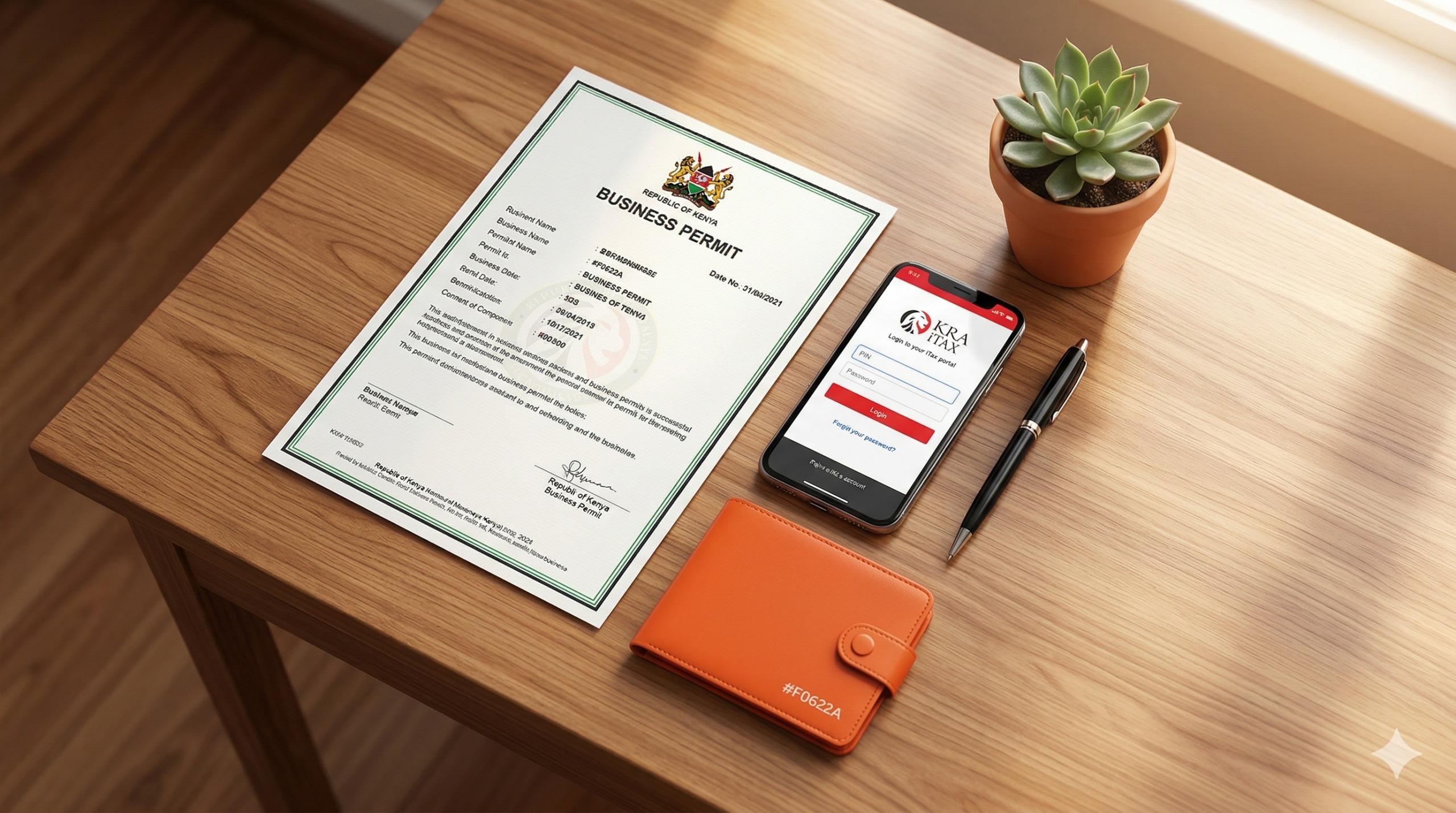
All rental income in Kenya is taxable under the Kenya Revenue Authority. For gross annual rental receipts between KES 288,000 and KES 15,000,000, the Monthly Rental Income (MRI) regime applies. The rate is a flat 10% of gross rental receipts — no deductions for expenses are permitted under this regime. You must file monthly returns through the KRA iTax portal by the 20th of the following month. Our dedicated guide covers the full short-term rental tax obligations in Kenya, including how to register, how to calculate MRI, and what records to keep.
County business permit
A single business permit from your county government is required if you are operating a short-term rental commercially. In Nairobi, this is issued by Nairobi City County and renewed annually. The cost varies by business type and location — typically KES 8,000 to KES 20,000 per year. Applications are made at the county business licensing office or, for some counties, through the eCitizen portal.
Tenancy agreement and building management
If you are a tenant subletting your rented apartment, your lease agreement almost certainly prohibits this without written landlord consent. Always obtain written permission before listing. If you own your property outright, check whether your building management company or estate association has rules about short-term letting in the complex — some newer Nairobi developments do.
⚠ Important
Operating without KRA registration and monthly MRI filings accumulates both the original tax liability and a 5% monthly penalty on unpaid amounts. The longer you delay registration, the larger the eventual bill. Registering is straightforward — it takes under an hour on iTax and protects your income from future enforcement action.
How to Price Your Listing for Maximum Earnings
Pricing is the single variable with the most immediate impact on your income — and the one most new hosts get wrong in the same direction: too low. Underpricing does not fill your calendar faster in the long run. It attracts price-sensitive guests, suppresses your average earnings, and makes it harder to raise rates later without losing ranking. Here is how to price correctly from the start.
Nairobi benchmark rates by neighbourhood (2026)
| Neighbourhood | Property Type | Nightly Rate Range | Primary Guest Type |
|---|---|---|---|
| Westlands | Studio | KES 3,500 – 5,500 | Business travellers, solo professionals |
| Westlands | 1-Bedroom | KES 5,000 – 9,000 | Business, NGO staff — best all-round |
| Westlands | 2-Bedroom | KES 8,000 – 14,000 | Long assignments, small teams |
| Kilimani | Studio | KES 2,800 – 4,500 | Budget professionals, extended stays |
| Kilimani | 1-Bedroom | KES 4,500 – 8,000 | Best value — high demand, mid-range |
| Upper Hill | 1-Bedroom | KES 6,000 – 11,000 | Financial sector, hospital visits |
| Gigiri / Runda | 1-Bedroom | KES 8,000 – 15,000 | UN staff, diplomatic corps |
| Karen | 2-Bedroom+ | KES 10,000 – 22,000 | Premium leisure, long-stay executives |
| Lavington | 1-Bedroom | KES 5,000 – 9,000 | Professionals, families, diaspora |
| Parklands | 1-Bedroom | KES 4,000 – 7,500 | Near Westlands, good value |
Dynamic pricing — the three adjustments that matter most
Setting a single flat rate is the fastest way to leave money on the table. Three adjustments deliver the largest income gains for Nairobi hosts. First, raise weekend rates by 15–25% — leisure guests and diaspora visitors book Friday and Saturday nights at a premium. Second, increase rates in peak travel windows: December–January (diaspora season), July–August (business conference season), and during major events like the Safari Rally or international summits. Third, set a minimum stay of two nights — single-night stays produce the highest cleaning cost relative to revenue and should be discouraged or priced at a premium.
📅 Peak Season Note
Nairobi’s highest-demand periods — December 15 to January 10 and July through August — see nightly rates climb 20–35% above baseline across all neighbourhoods. Quality properties in Westlands and Kilimani book out weeks in advance during these windows. Set your peak rates before demand arrives, not after.
Trubay Stayz hosts receive dynamic pricing guidance for their specific neighbourhood — updated monthly based on live Nairobi booking data. No guesswork required. Get Pricing Support →
Is Airbnb Hosting in Kenya Worth It in 2026?
The direct answer is yes — for a well-located, properly presented property managed with real attention to occupancy and pricing. But short-term rental is not passive income. It requires active management, genuine care for the guest experience, and a commitment to compliance. What it rewards in return is a significantly higher monthly yield than any long-term lease will provide.
Realistic income comparison — one-bedroom in mid-market Nairobi
| Scenario | Gross Monthly (KES) | Net After Costs (KES) | vs Long-Term |
|---|---|---|---|
| Long-term tenancy | 32,000 | 29,000 – 31,000 | Baseline |
| Self-managed STR — 55% occupancy | 66,000 | 40,000 – 48,000 | +38–66% |
| Platform-managed STR — 65% occupancy | 78,000 | 46,000 – 58,000 | +58–100% |
| Platform-managed STR — 80% occupancy | 96,000 | 58,000 – 74,000 | +88–155% |
These figures use a baseline nightly rate of KES 6,000 — realistic for a well-presented one-bedroom in Kilimani, Lavington, or Parklands. At 80% occupancy across 30 days, gross income reaches KES 144,000. At 55% occupancy — a conservative starting point for a new listing — gross income is KES 99,000. Both figures dwarf the long-term equivalent, even before accounting for the flexibility benefits.
When short-term rental is not the right choice
Short-term rental is less suitable if your property is in a location with minimal business or leisure travel demand — outer suburbs, industrial areas, or towns without an established visitor economy. It also does not suit landlords who cannot tolerate variable month-to-month income, or who are not willing to invest in furnishing and maintaining a guest-ready standard. In those cases, long-term tenancy remains the more appropriate model.
Your Next Steps — Getting Your First Booking This Month
Starting does not require perfection. It requires preparation. Most hosts who take the right steps upfront receive their first booking within a week of going live. Here is the sequence that produces consistent results:
01
Check your legal position
Review your tenancy or mortgage agreement. If you own outright, check the estate or building management rules. Register with KRA iTax if you have not already done so. This step cannot be skipped.
02
Furnish and photograph your property
Prioritise bedding, Wi-Fi, and a functional workspace above everything else. Book a professional photographer — the KES 8,000–12,000 investment returns within the first week of bookings.
03
Create your listings
List on Airbnb for international reach and on Trubay Stayz for local and East African bookings. The two audiences barely overlap — both listings are additive, not duplicative.
04
Set a competitive opening rate
Start 10–15% below your target rate to build reviews quickly. Once your property has 5–10 strong reviews, raise your price to the full market rate. Review velocity matters more than day-one pricing.
05
Respond to every inquiry within 1 hour
Response time is a ranking factor on every platform. Set up notifications on your phone and reply to every inquiry the same day. The first months of operation set your platform standing for years.
06
Request a review after every stay
Send a message after checkout thanking your guest and politely mentioning that a review helps your listing. Reviews are the most valuable long-term asset a short-term rental host owns.
If you would rather hand off the entire setup process, Trubay Stayz manages everything from listing creation to guest communication and pricing — so your property can go live in under two weeks without you managing any of the operational details.
Start Earning From Your Property This Month
Join Trubay Stayz and let our team handle the setup, the guests, and the pricing — while you receive M-Pesa payouts within 24 hours of every completed stay.
📲 Join the Trubay Stayz WhatsApp channel for weekly host income tips and Nairobi market updates: Trubay Stayz WhatsApp channel Sign Up as a Host →
Already earning from short-term rental? Read our complete guide to how much Kenyan properties actually earn with city-by-city income breakdowns for 2026. See Income Figures →
To start Airbnb hosting in Kenya, first confirm your tenancy or ownership agreement permits short-term letting. Register with KRA iTax for rental income tax under the Monthly Rental Income (MRI) regime.
Furnish your property to a guest-ready standard — prioritising bedding, Wi-Fi, and a dedicated workspace. Book a professional photographer. Then create listings on Airbnb for international guests and on Trubay Stayz for local and East African bookings. Most hosts receive their first booking within days of going live on both platforms.
A one-bedroom apartment in Nairobi’s mid-market neighbourhoods — Kilimani, Westlands, Lavington — earns KES 60,000 to KES 110,000 gross per month at 60–80% occupancy. After operating costs and management fees, net income typically exceeds long-term rental yield by 60–120%.
Properties in premium locations such as Karen, Gigiri, or Riverside Drive earn significantly more. Earnings are covered in full in our Kenya short-term rental income guide.
Yes. You need three things: KRA registration for Monthly Rental Income tax (mandatory from your first rental payment), a county single business permit from your local county government, and compliance with the Tourism Regulatory Authority of Kenya (TRAB) licensing framework for short-term rental operators. Requirements vary by county — confirm current requirements through the KRA iTax portal and your county government licensing office.
Airbnb provides global reach and a large international guest audience. Trubay Stayz is built specifically for the Kenyan and East African market — with M-Pesa payouts within 24 hours of checkout, local guest verification, Kenyan-language host support, and marketing on the channels Kenyan guests use.
Most high-earning Nairobi hosts list on both platforms: Airbnb for international guests and Trubay Stayz for domestic and regional bookings. The two audiences barely overlap, so both listings are additive.
Yes — through Trubay Stayz, guests can pay via M-Pesa, and hosts receive their payouts via M-Pesa within 24 hours of a completed stay. Airbnb does not currently support M-Pesa payments — it processes in USD via bank transfer, which can take 3–5 business days and incurs currency conversion costs.
For Kenyan hosts who manage their income through mobile money, Trubay Stayz is a significantly more practical channel.
In most established Nairobi neighbourhoods, yes — significantly. A property earning KES 32,000 per month on a long-term lease typically earns KES 70,000 to KES 110,000 gross on the short-term market at 60–80% occupancy. Net income after operating costs and management fees usually exceeds long-term rental income by 58–120%, depending on location, specification, and management quality. The gap is widest in Westlands, Kilimani, Karen, and Gigiri.