


DIY Property Management Kenya vs Hiring a Manager: The Honest 2026 Guide


By Oscar Murimi · Short-Term Rental Specialist, Trubay Stayz
Updated: March 2026⏱ 10 min read
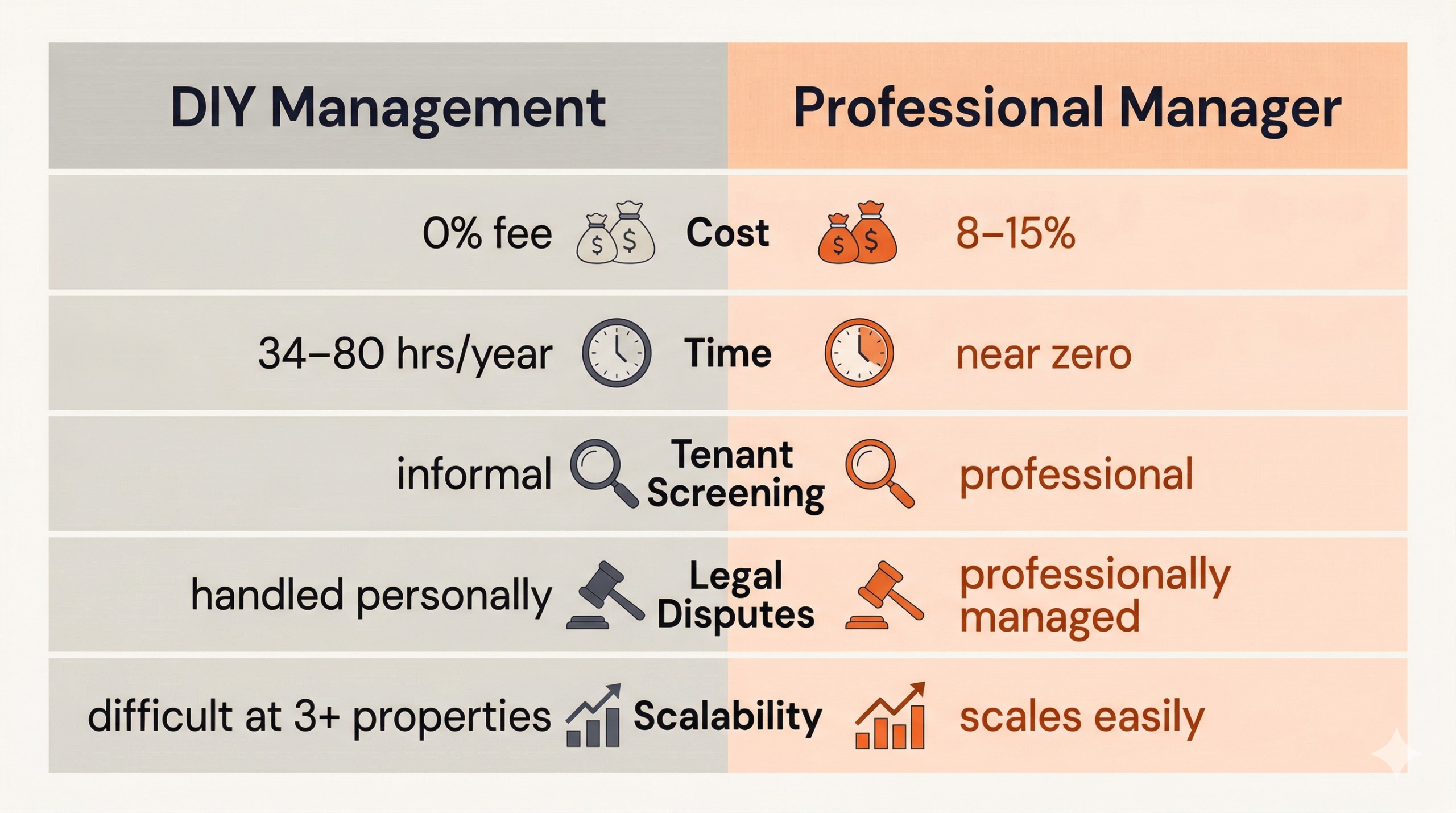
DIY property management in Kenya works best for owners with one or two properties, who live locally, have a flexible schedule, and whose time is worth less than KES 1,500 per hour. Hiring a professional manager makes more sense for diaspora owners, those with three or more properties, owners with demanding careers, or anyone who has experienced tenant disputes or arrears. For short-term rental properties, a local platform like Trubay Stayz provides management-equivalent support without the cost structure of a traditional manager.
Table of Contents
- Why this decision is more nuanced than most guides admit
- The real cost of DIY property management in Kenya
- What you actually gain when you hire a professional manager
- When DIY property management in Kenya makes financial sense
- Self-assessment: Which option fits your situation?
- The hybrid approach — the middle path most guides ignore
- Short-term rentals: a different calculation entirely
DIY property management in Kenya is a genuinely viable option for some owners — and a quietly expensive mistake for others. The frustrating reality is that most guides on this topic give one-sided answers. They either champion self-management as the obvious way to maximise income, or they argue that professional management always pays for itself. Neither position is universally true. The right answer depends on four variables specific to your situation: how many properties you own, where you live relative to those properties, how much your time is worth, and what your risk tolerance is for tenant-related problems.
This guide gives you a framework for making that decision clearly. It covers the real, full cost of managing your own property in Kenya — including the hours that most owners underestimate — and the genuine advantages that a good professional manager provides. It also includes a practical self-assessment to help you diagnose which option fits your specific situation, and an honest look at when neither traditional option is the right answer.
Why This Decision Is More Nuanced Than Most Guides Admit
The standard framing of this decision — “save the management fee vs save your time” — misses two important dimensions. First, it treats management fees as a fixed cost, when in reality the total cost of professional management varies enormously depending on what is and is not included in a manager’s stated percentage. Second, it treats DIY as uniformly simpler than it is, ignoring the fact that property management in Kenya includes legally and emotionally demanding situations that many owners are genuinely not equipped to handle alone.
Furthermore, this decision is not permanent. Many Kenyan property owners start by managing their first property themselves — learning the market, building contractor contacts, and understanding their tenants’ patterns — and then transition to professional management as their portfolio grows or their schedule becomes more demanding. The most important thing is making the right choice for where you are right now, not locking yourself into a position that stops making sense in eighteen months.
The question is never simply “DIY or manager?” The more useful question is: “What is the total annual cost of each option — in money and in hours — and which one leaves me with more net income and less disruption to my life?” This guide gives you the framework to answer that question for your specific property and situation.
The Real Cost of DIY Property Management in Kenya
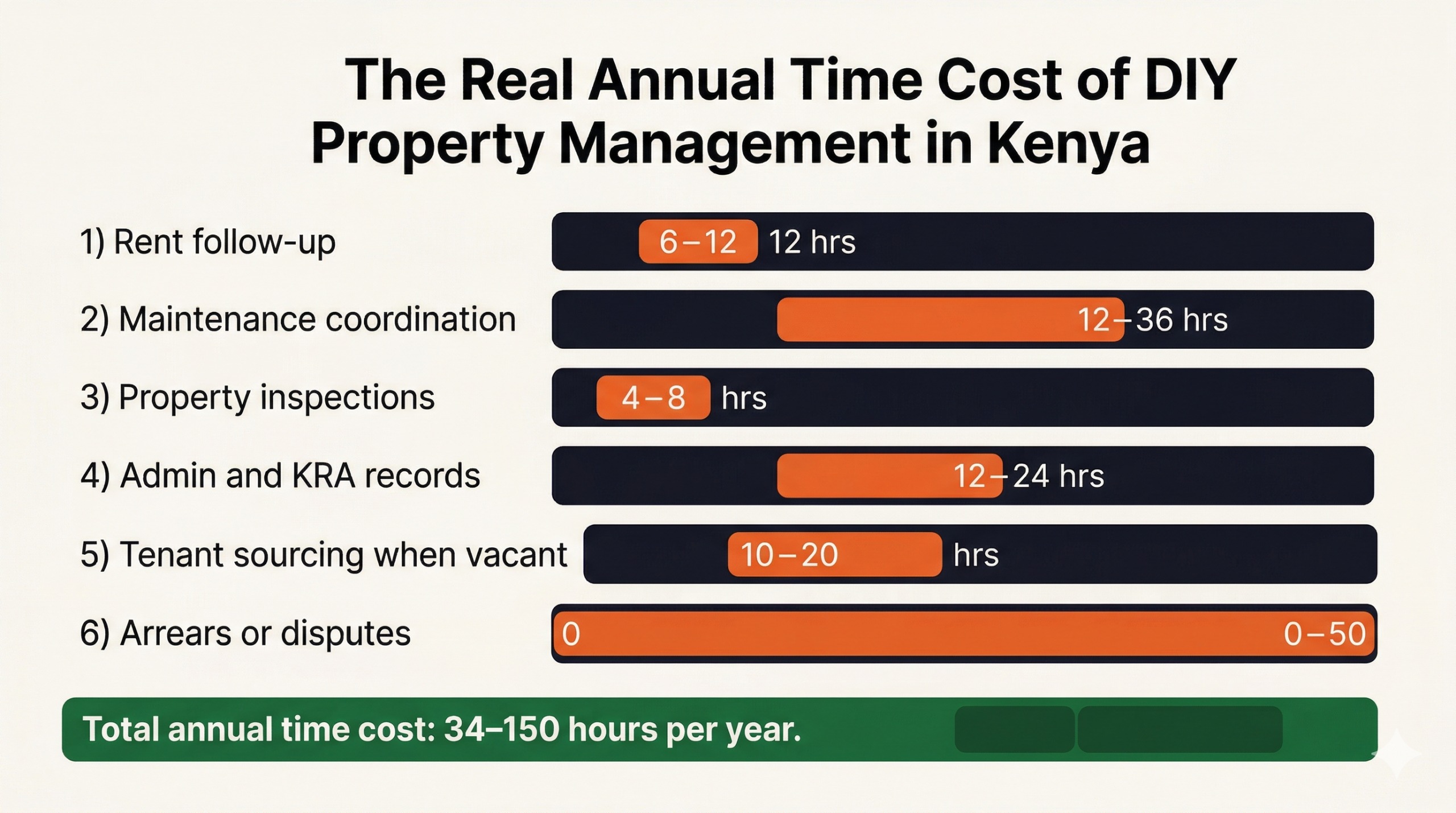
The hidden cost of DIY property management in Kenya is not money — it is time. Most owners who choose to manage their own properties correctly estimate the monthly rent collection and maintenance calls, but significantly underestimate the time cost of two events that happen less frequently but require far more effort: finding a new tenant when one leaves, and handling a tenant dispute or arrears situation when one arises.
The table below shows a realistic annual time audit for a single well-managed rental property in Nairobi, under a best-case scenario with a reliable long-term tenant.
| Management Task | Frequency | Hours per Event | Annual Hours | Notes |
|---|---|---|---|---|
| Rent follow-up and collection | Monthly | 0.5–1 hr | 6–12 hrs | Reliable tenant. Doubles with arrears problems. |
| Maintenance coordination | Monthly avg. | 1–3 hrs | 12–36 hrs | Varies widely by property age and condition. |
| Property inspections | 2–4×/year | 2 hrs each | 4–8 hrs | Including travel time. |
| Admin (receipts, KRA, records) | Monthly | 1–2 hrs | 12–24 hrs | More complex with multiple properties. |
| Tenant sourcing (when vacant) | Per vacancy | 10–20 hrs | 10–20 hrs | Even one vacancy per year adds significantly. |
| Arrears or legal dispute | If it happens | 20–50 hrs | 0–50 hrs | Kenya eviction process can take 3–6 months. |
| Annual Total (best case, no major events) | 34–80 hrs/yr | At one vacancy or one arrears situation: 54–150 hrs/yr | ||
With this time picture clear, the financial calculation becomes straightforward. For a property earning KES 50,000 per month, professional management at 10% costs KES 5,000 per month — or KES 60,000 per year. Against the 34–80 hours of annual management time in a best-case scenario, that is roughly KES 750–1,765 per hour of management work avoided. If your time is worth more than KES 1,500 per hour to you professionally or personally, professional management already pays for itself before any major tenant event occurs.
📌 The Arrears Reality
Tenant arrears are more common in Kenya than most first-time landlords expect. When a tenant falls behind on rent, the emotional and time cost of managing that situation personally — calls, visits, notices, potential court action — is significant. A professional manager provides a buffer that makes these situations far less disruptive to your life, and typically has legal contacts and experience that resolve them faster. For a full picture of Kenya’s rental income legal framework, our short-term rental laws guide covers the relevant regulations.
What You Actually Gain When You Hire a Professional Manager
The honest case for professional management is not just about saving time. A genuinely good property manager in Kenya provides three things that DIY management rarely replicates: better tenant quality, faster problem resolution, and a level of professional distance that makes difficult situations much easier to navigate.
Better Tenant Screening
Experienced property managers have established processes for tenant verification — employment confirmation, previous landlord references, background checks — that most individual owners skip because they feel invasive or awkward to conduct personally. The quality of your tenant is the single biggest determinant of how smoothly your property runs month to month. One bad tenant discovered at screening is worth far more than a year of management fees.
A Professional Contractor Network
Managing a property in Nairobi requires reliable plumbers, electricians, painters, and general maintenance contacts available at short notice. A manager with an established network typically resolves maintenance issues faster and at better prices than an owner sourcing contractors independently. Their volume of business gives them pricing leverage that an individual property owner rarely has.
Legal Knowledge and Experience
Kenya’s tenancy law — including notice periods, deposit rules, and the eviction process — requires specific procedural knowledge to navigate correctly. An error in the eviction process can invalidate months of legal action and restart the clock entirely. Professional managers who handle these situations regularly make fewer procedural mistakes, and many have established relationships with advocates who specialise in landlord-tenant disputes.
Emotional Distance
Perhaps the most underrated advantage of professional management is the buffer it places between you and your tenants. When rent is late, when a maintenance issue is disputed, when a tenant wants to renegotiate their lease — having a manager as the first point of contact removes the emotional weight of those conversations from your daily life. This matters more than most owners expect until they have experienced a difficult tenant relationship firsthand.
Before comparing management options, it helps to know exactly what your property could earn. Our Kenya rental income guide gives you the real numbers by neighbourhood and property type. See the Earnings Guide →
When DIY Property Management in Kenya Makes Financial Sense
DIY property management in Kenya is the right choice under a specific combination of circumstances — not universally, and not permanently. If most of the following conditions apply to your situation, self-management is likely worth the savings.
🔧
DIY Works When…
- You own one or two properties only
- You live in the same city as your property
- Your current tenant is established and reliable
- You have a flexible schedule or work from home
- The property is relatively new and low-maintenance
- You have trusted maintenance contacts already
- You are building market knowledge before scaling
- Your hourly time value is below KES 1,500
🏢
Hiring Makes Sense When…
- You own three or more properties
- You live abroad or travel frequently
- You have a demanding full-time job or business
- You have experienced arrears or tenant disputes
- You have no reliable local maintenance contacts
- Your property is in a high-maintenance older building
- You have no familiarity with Kenyan tenancy law
- Your hourly time value exceeds KES 1,500
📊 Real Cost Calculation — Property at KES 50,000/Month Rent
Annual gross rent income KES 600,000
Professional management fee (10%)−KES 60,000/yr
DIY time cost (50 hrs/yr × KES 1,500/hr)−KES 75,000/yr
DIY time cost (50 hrs/yr × KES 800/hr)−KES 40,000/yr
Hidden management fees estimate (setup, vacancy, maintenance markup)−KES 15,000–25,000/yr
Verdict: If your time is worth above ~KES 1,200–1,500/hr, professional management costs the same as or less than DIY. Below that threshold, DIY saves money — but only in a year without major tenant events. Run your numbers
Self-Assessment: Which Option Fits Your Situation?
Answer each question honestly. The pattern of your answers will point clearly toward one option or the other — and in some cases, toward the hybrid approach covered in Section 6.
🔍 DIY vs Manager Self-Assessment
How many rental properties do you currently own or manage?
1–2 → DIY3+ → Hire
Do you live within 30 minutes of your rental property?
Yes → DIY No → Hire
How would you describe your current work schedule?
Flexible → DIY Demanding → Hire
Have you had a tenant miss rent or cause a dispute in the past two years?
No → DIY Yes → Hire
Do you have a reliable plumber, electrician, and general handyman you can call at short notice?
Yes → DIY No → Hire
Are you comfortable personally confronting a tenant about late rent?
Yes → DIY No → Hire
Do you know the basic legal process for a tenant eviction in Kenya?
Yes → DIY No → Hire
Is your property intended primarily as a short-term rental (guests, not long-term tenants)?
Yes → See Section 7
📊 Real Cost Calculation — Property at KES 50,000/Month Rent
Annual gross rent income KES 600,000
Professional management fee (10%)−KES 60,000/yr
DIY time cost (50 hrs/yr × KES 1,500/hr)−KES 75,000/yr
DIY time cost (50 hrs/yr × KES 800/hr)−KES 40,000/yr
Hidden management fees estimate (setup, vacancy, maintenance markup)−KES 15,000–25,000/yr
Verdict: If your time is worth above ~KES 1,200–1,500/hr, professional management costs the same as or less than DIY. Below that threshold, DIY saves money — but only in a year without major tenant events. Run your numbers
If your answers are mostly in the “DIY” column, self-management is likely the right starting point for you. Start tracking your hours honestly after the first three months — if you are consistently over 8 hours per month, revisit this calculation. If your answers are mostly “Hire”: professional management will almost certainly pay for itself in time, stress reduction, and risk mitigation. For details on what that should cost and what to look for, our property management fees guide gives you the full Kenya market picture.
Already considering co-hosting as a middle path for your short-stay property? Our co-hosting guide covers the Kenya market in full — fees, finding the right person, and when a platform is the better call. Read the Co-Hosting Guide →
The Hybrid Approach — The Middle Path Most Guides Ignore
Many Kenyan property owners settle into a middle position that is more practical than either full DIY or full professional management — and this approach is worth considering before committing to either extreme.
The most common hybrid model works like this: the owner manages the ongoing tenant relationship directly — rent collection, communication, routine maintenance — but outsources specific high-complexity tasks to professionals. For example, paying a registered agent one month’s rent to source and screen a new tenant when a vacancy arises, while handling everything else independently. This captures most of the cost savings of DIY while getting professional expertise at the moments it matters most.
A second hybrid approach that works well for multi-property owners is to self-manage familiar, stable properties while putting newer or more complex properties under professional management until they stabilise. This limits exposure without the all-or-nothing cost of full professional management across the entire portfolio.
Short-Term Rentals: A Different Calculation Entirely
If your property is intended as a short-term rental — serviced accommodation for guests rather than long-term tenants — the DIY versus manager decision takes on a completely different character. Short-term rental management is fundamentally more demanding than long-term rental management. Guest communication happens daily, check-ins occur at unpredictable hours, cleaning must happen between every booking, and pricing requires active weekly review. For most working professionals in Kenya, true DIY short-term rental management is not a realistic long-term strategy unless the property is nearby and the owner has a genuinely flexible schedule.
However, the traditional alternative — hiring a short-term rental manager — comes with the compounding fee problem we described in our property management fees guide: Airbnb’s platform fee of 17–20% stacked on top of a manager’s 20–30% can consume 35–40% of every booking before the income reaches the owner. This makes the finances of professionally managed short-term rentals significantly less attractive than the income headline suggests.
This is precisely the problem that a purpose-built local platform solves. Listing your short-term rental on Trubay Stayz provides the operational support that a manager would otherwise supply — guest communication infrastructure, booking management, local host assistance, and payment processing — as part of the platform’s structure, not as an additional layer of fees on top of an existing platform cost. Payouts arrive directly in Kenyan Shillings via M-Pesa, with no currency conversion loss. For property owners who want short-term rental income without short-term rental management complexity, this is the option that actually resolves the problem.
If your property could earn more as a short-stay rental than a long-term lease — but you do not have time to manage it yourself — Trubay Stayz gives you a third option that costs less than a traditional manager. List on Trubay Stayz →
Still Deciding? Let Us Help You Think It Through.
Join hundreds of Kenyan property owners already earning consistent short-stay income on Trubay Stayz — with local support, M-Pesa payouts, and no management complexity.
📲 Join our WhatsApp channel for weekly Kenya property income tips and host updates.
Become a Host on Trubay Stayz →
DIY property management in Kenya is a good option for owners with one or two properties who live locally, have a flexible schedule, and whose time is worth less than approximately KES 1,500 per hour. However, it becomes progressively more difficult and expensive in terms of time as your portfolio grows, if you live abroad, or if you encounter tenant arrears or disputes. For short-term rental properties, DIY management is particularly demanding — daily guest communication and unpredictable check-ins make it unsustainable for most working professionals.
A single well-managed long-term rental property in Kenya requires between 34 and 80 hours per year in a best-case scenario with a reliable tenant. This increases significantly in years where a tenant vacancy occurs (add 10–20 hours to find and screen a new tenant) or where arrears or disputes arise (add 20–50 hours or more, depending on severity). Most owners significantly underestimate this time cost before they start managing themselves.
A Kenyan property owner should hire a professional manager when they own three or more properties, live abroad or travel frequently, have a demanding full-time career, have no reliable maintenance contractor network, have experienced tenant disputes or arrears, or when their time is consistently worth more than KES 1,500 per hour. For diaspora Kenyan property owners, especially, professional management or listing on a dedicated local platform like Trubay Stayz is almost always the better choice.
For a property earning KES 50,000 per month, professional management at 10% costs KES 60,000 per year. DIY management takes approximately 34–80 hours per year in a stable scenario. The financial breakeven — where DIY time costs the same as professional management — occurs at roughly KES 750–1,765 per hour of management time. If your time is worth more than KES 1,500 per hour professionally, professional management typically costs the same or less than DIY when all factors are considered.
DIY management for a short-term rental in Kenya is significantly more demanding than for a long-term rental. Guest communication happens daily, check-ins are unpredictable, cleaning must occur between every booking, and pricing requires regular adjustment. It is viable for owner-operators with flexible schedules and properties close to where they live. For most working professionals, a platform like Trubay Stayz provides the management support of a professional manager built into the platform structure — without the compounding fees of using Airbnb plus a separate manager.
The hybrid approach to property management in Kenya involves handling the day-to-day tenant relationship independently — rent collection, routine communication, minor maintenance — while outsourcing specific high-complexity tasks to professionals. The most common example is paying a registered agent one month’s rent to find and screen a new tenant during a vacancy, while managing everything else yourself. This captures most of the cost savings of DIY while ensuring professional expertise is applied where it matters most.

