How Much Can You Earn from Short-Term Rentals in Kenya? (2026 Guide)

By Oscar Murimi — Short-Term Rental Specialist
Short-Term Rental Specialist | Helped 200+ Kenyan property owners launch rentals. Last Updated: March 2026⏱ Reading Time: 8 minutes
📌 Quick Answer
Kenyan property owners earn between KES 30,000 and KES 180,000 per month from short-term rentals, depending on location, property size, and occupancy rate. A one-bedroom apartment in Westlands or Kilimani typically earns KES 60,000–90,000 per month at 70% occupancy. Properties in Diani or Naivasha earn KES 45,000–120,000 monthly during peak season.

Table of Contents
- The opportunity most Kenyan property owners are missing
- What determines how much you earn
- Short-term rental income by Nairobi neighbourhood (2026)
- Earnings outside Nairobi: Mombasa, Diani, Naivasha, Nakuru
- Realistic monthly income scenarios
- What Trubay Stayz hosts earn compared to Airbnb
- How to start earning this month
- Frequently asked questions
You own a property in Nairobi — or maybe in Mombasa, Naivasha, or Nakuru. It might be sitting empty right now, or it may be occupied by a long-term tenant paying a fixed monthly rent that hasn’t changed in two years. Meanwhile, guests from across Kenya and the world are searching online every day for exactly the kind of space you own — and paying two, three, sometimes four times what a long-term tenant pays, for a single night.
The short-term rental market in Kenya has grown substantially over the past four years. Domestic travel has increased. Business travel continues to rise in Nairobi. Coastal tourism is recovering strongly. The demand for well-furnished, privately managed short-stay accommodation is real — and the supply of quality options remains far lower than the demand.
This guide gives you the real numbers. Not estimates borrowed from global averages, but figures grounded in the Kenyan market — by neighbourhood, property size, and season — so you can make a clear, informed decision about whether short-term rental income is right for your property.
What Determines How Much You Earn from Short-Term Rentals in Kenya?

Before looking at specific figures, it helps to understand the four factors that most directly influence your monthly short-term rental income in Kenya. These are the variables you can actually control or optimise.
1. Location
Location is the single biggest determinant of both your nightly rate and your occupancy rate. Properties in Nairobi’s established short-stay neighbourhoods: Westlands, Kilimani, Lavington, Parklands — command premium nightly rates and maintain high occupancy year-round because of proximity to business districts, restaurants, and transport. Properties further from these hubs charge lower rates and experience more seasonal variation.
2. Property Size and Quality
A fully furnished, well-photographed studio consistently outperforms a bare two-bedroom apartment. Guests on short stays are paying for comfort and convenience, not just square footage. Professional linens, a functional kitchen, reliable Wi-Fi, and clean, modern decor are the minimum standards for competitive listings in 2026.
3. Occupancy Rate
Your occupancy rate, which is the percentage of nights your property is booked, directly multiplies your nightly rate into monthly income. A property earning KES 4,000 per night at 50% occupancy earns KES 60,000 per month. The same property at 75% occupancy earns KES 90,000. Managing your listing well, responding quickly to enquiries, and maintaining strong reviews drives occupancy up.
4. Platform and Fees
The platform you list on significantly affects your net earnings. Airbnb charges hosts between 14–17% in combined service fees. Local platforms like Trubay Stayz operate on more favourable host terms, meaning a larger proportion of each booking reaches your account. Over a full year, this difference compounds into a meaningful income gap.
Short-Term Rental Income by Nairobi Neighbourhood (2026)
The following figures represent realistic monthly earnings based on current market rates in Nairobi. They assume a reasonably well-furnished property, active listing management, and an occupancy rate of 65–75%.
| Neighbourhood | Property Type | Avg. Nightly Rate | Monthly (65% occ.) | Monthly (75% occ.) |
|---|---|---|---|---|
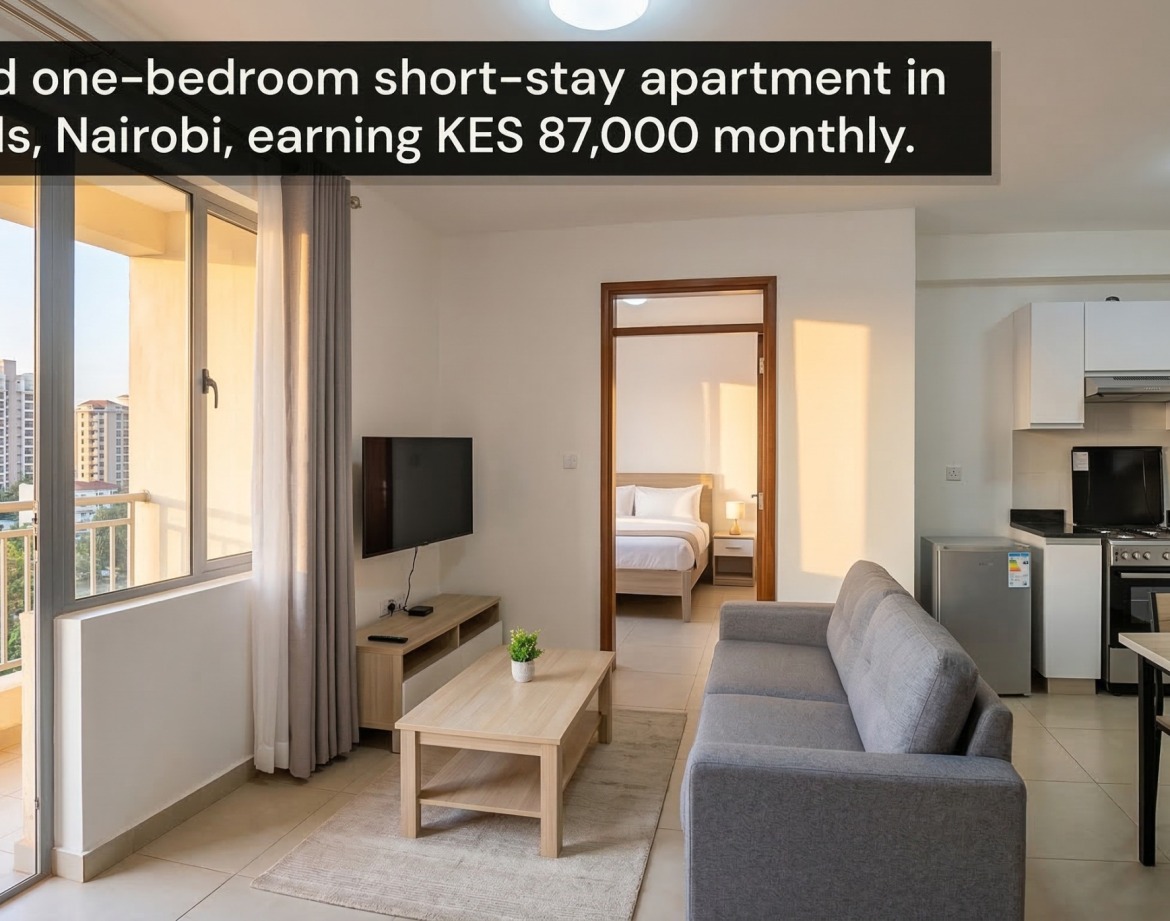
| Westlands | 1-Bedroom Apt | KES 4,500 | KES 87,750 | KES 101,250 |
| Kilimani | Studio | KES 3,200 | KES 62,400 | KES 72,000 |
| Kilimani | 2-Bedroom Apt | KES 6,500 | KES 126,750 | KES 146,250 |
| Lavington | 2-Bedroom Apt | KES 7,000 | KES 136,500 | KES 157,500 |
| South B / C | Studio | KES 2,800 | KES 54,600 | KES 63,000 |
| Ruaka / Gigiri | 2-Bedroom Apt | KES 5,500 | KES 107,250 | KES 123,750 |
| Roysambu | Studio | KES 2,500 | KES 48,750 | KES 56,250 |

Short-Term Rental Earnings Outside Nairobi
Nairobi is not the only market worth considering. Several other Kenyan cities and destinations offer strong short-term rental income potential, particularly for hosts willing to target specific guest segments.
Diani Beach
Diani remains Kenya’s most sought-after coastal destination. A well-furnished beachfront or near-beach villa earns KES 8,000–25,000 per night during peak season (July–August and December–January). Even a modest 2-bedroom apartment 500 metres from the beach commands KES 4,500–7,000 per night. Monthly earnings for managed properties range from KES 90,000 to KES 200,000+ during peak months.
Naivasha
Naivasha is a weekend getaway destination for Nairobi residents. Demand peaks on Friday and Saturday nights and during public holidays. A comfortable 2-bedroom cottage or house earns KES 5,000–12,000 per night on weekends, with monthly totals typically ranging from KES 60,000 to KES 120,000 for active listings.
Nakuru
Nakuru is growing as both a business and tourism destination following its city status. A 2–3 bedroom apartment near Nakuru CBD earns KES 4,000–10,000 per night. Monthly totals for managed properties currently range from KES 50,000 to KES 90,000, with strong growth expected as the city develops.
Mombasa
Mombasa’s city centre and beach-adjacent areas attract both business and leisure travellers. A 1-bedroom apartment in Nyali or Bamburi earns KES 3,500–6,000 per night with monthly totals of KES 55,000–100,000 at sustainable occupancy rates.
The most important number to understand is not the nightly rate — it is the annual net income. A property earning KES 80,000 per month from short-term stays, minus platform fees of 8%, cleaning costs of KES 5,000 per month, and utilities of KES 6,000 per month, nets approximately KES 62,600 per month — or KES 751,200 per year. That same property on a long-term lease might earn KES 35,000 per month — KES 420,000 per year. The short-term rental advantage, managed well, is nearly double.
What Trubay Stayz Hosts Earn Compared to Airbnb
This is a direct and honest comparison that every Kenyan property owner deserves to see before making a listing decision.
Airbnb charges a host service fee of 3% on every booking, plus a guest service fee of 14–16%. This means that for a KES 5,000 per night booking, Airbnb collects approximately KES 900–1,000 in combined fees before you receive your payout. Additionally, Airbnb’s payouts in Kenya are processed in USD and converted to KES, introducing exchange rate losses on every transaction.
Trubay Stayz is a Kenyan platform built specifically for the Kenyan market. Payouts are processed directly in KES via M-Pesa, eliminating currency conversion losses. Host fees are structured to ensure a larger share of every booking reaches the host, and you are supported by a locally based team that understands the Kenyan property landscape. For a full breakdown of the comparison, read our guide on why Kenyan hosts are moving away from Airbnb.
How to Start Earning Short-Term Rental Income in Kenya This Month
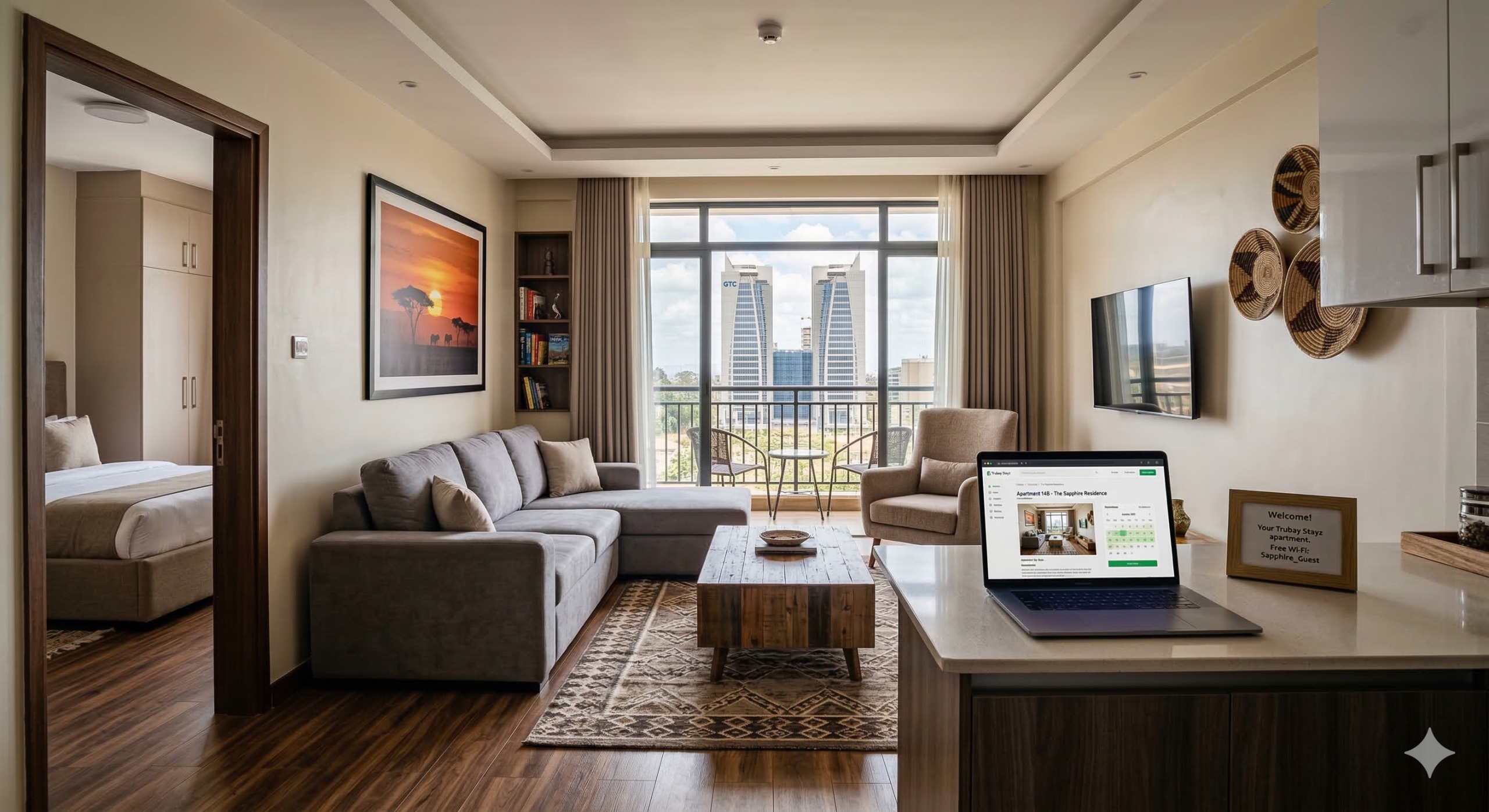
The path from an empty or under-earning property to an active short-term rental income stream is simpler than most property owners expect. Here is the process, step by step.
- Prepare the property. Furnish it to a comfortable standard — clean linen, functional kitchen essentials, a reliable Wi-Fi connection, and clear house rules. You do not need to spend a fortune. A well-styled, clean space with good photographs outperforms an expensive but poorly presented one every time.
- Take quality photographs. Natural light, wide angles, and tidy rooms are the difference between a listing that gets bookings and one that doesn’t. A few hours on a bright morning with a decent smartphone camera is sufficient to start.
- List on Trubay Stayz. The listing process takes under 30 minutes. Your property goes live on a platform built for the Kenyan market, with M-Pesa payment integration, local guest support, and a growing base of domestic and international travellers.
- Set your pricing. Use the figures in this guide as a starting reference. Begin slightly below the market average to build reviews quickly, then adjust upwards as your rating improves. Read our full pricing guide for Kenyan vacation rentals for a detailed strategy.
- Manage and optimise. Respond to enquiries quickly, keep your calendar updated, and ask guests for reviews after each stay. These three habits, maintained consistently, drive your occupancy rate up and your income with it.
Understanding the legal requirements for short-term rentals in Kenya is also an important part of running your listing responsibly and avoiding compliance issues. We have covered this in full in our dedicated guide.
Your Property Can Start Earning This Month

Join hundreds of Kenyan property owners already earning consistent short-term rental income on Trubay Stayz — Kenya’s local platform with M-Pesa payouts and real local support. Become a Host on Trubay Stayz →
FAQs
Kenyan short-term rental hosts earn between KES 30,000 and KES 180,000 per month, depending on location, property size, and occupancy rate. A studio in Nairobi’s Kilimani area typically earns KES 55,000–72,000 per month at 65–75% occupancy.
Yes. Rental income in Kenya is subject to tax under the Kenya Revenue Authority guidelines. Monthly rental income above KES 288,000 per year falls under the Residential Rental Income Tax at a flat rate of 10%. We recommend consulting a KRA-registered tax advisor for your specific situation.
Westlands, Kilimani, and Lavington consistently deliver the highest short-term rental income in Nairobi due to their proximity to business districts, restaurants, and transport links. These areas maintain high occupancy year-round from both business and leisure travellers.
Trubay Stayz offers more favourable host fee structures than Airbnb and processes payouts directly in Kenyan Shillings via M-Pesa, eliminating currency conversion losses. For a detailed comparison, see our guide on Airbnb alternatives in Kenya.
A good occupancy rate for a Kenyan short-term rental is 65–75%. Properties in prime Nairobi neighbourhoods with strong listing management regularly achieve 70–80% occupancy. New listings typically reach 50–60% occupancy in their first 60 days