


Airbnb Co-Hosting Kenya: Complete Guide for Property Owners (2026)


By Oscar Murimi · Short-Term Rental Specialist, Trubay StayzUpdated: March 2026⏱ 9 min read
Airbnb co-hosting in Kenya is an arrangement where a property owner invites a trusted person — the co-host — to help manage their Airbnb listing. The co-host handles tasks such as guest communication, check-ins, cleaning coordination, and listing management. In return, the co-host earns a percentage of each booking — typically 15 to 25% of the nightly rate in the Kenyan market. Co-hosting is particularly common among diaspora property owners who cannot manage their Nairobi or coastal properties from abroad.
Table of Contents
- Why Kenyan property owners are turning to co-hosting
- How Airbnb co-hosting in Kenya actually works
- What a co-host does — and what they should not do
- What co-hosting costs: typical rates in the Kenyan market
- Finding the right Airbnb co-host in Kenya
- What your co-hosting agreement must include
- When co-hosting is not enough — a better alternative
Airbnb co-hosting in Kenya has become one of the most practical solutions for property owners who want to earn from short-term rentals without managing every detail themselves. Perhaps you own an apartment in Kilimani but spend most of the week at work or out of the country. Probably your Diani holiday home sits empty between your own visits. Maybe you have already listed on Airbnb and quickly discovered that responding to guests at 11 pm on a Tuesday is not what you signed up for. Co-hosting exists precisely for situations like these — and in Kenya, demand for reliable co-hosts is growing faster than supply.
This guide covers everything you need to make a clear, informed decision about co-hosting. How the arrangement works, what to pay, what to look for in a co-host, what your agreement must include, and — importantly — when a local platform like Trubay Stayz gives you something co-hosting simply cannot.
Why Kenyan Property Owners Are Turning to Co-Hosting
The short-term rental market in Kenya has grown significantly over the past four years. More property owners are listing their homes, apartments, and holiday properties as short-stay accommodation — attracted by the income potential that our earnings guide shows in detail. However, managing a short-stay property is not passive. Guests ask questions before booking. Arrivals happen at unpredictable hours. Things break. Reviews must be responded to. Prices need adjusting.
For many property owners, this operational reality collides with an equally real constraint: they simply do not have the time, the proximity, or the energy to do it all themselves. Three specific groups find co-hosting particularly valuable in Kenya.
Diaspora Property Owners
A substantial number of Kenyan properties — particularly in Nairobi’s prime neighbourhoods and along the coast — are owned by Kenyans living in the UK, the US, Canada, and the Gulf. These owners want their properties earning income rather than sitting empty or being under-rented on long-term leases. However, they cannot physically manage check-ins, respond to guests in real time, or coordinate cleaners. A reliable local co-host solves this entirely — and is often the difference between a property earning nothing and earning KES 80,000 a month.
Owners with Full-Time Commitments
Many Kenyan property owners have demanding full-time jobs or businesses. They can handle the strategic decisions — pricing, property upgrades, platform selection — but not the daily operational demands of hosting. A co-host absorbs the operational load while the owner retains control over the listing and receives the majority of the income.
Multi-Property Hosts
As Kenyan hosts grow their portfolios from one property to three or four, managing each listing individually becomes unsustainable. Co-hosting — or evolving into a managed model through a platform like Trubay Stayz — allows hosts to scale their income without scaling their working hours proportionally.
How Airbnb Co-Hosting in Kenya Actually Works
The technical process of setting up co-hosting on Airbnb is straightforward. As the primary host, you go into your listing on the Airbnb platform, navigate to Listing → Co-Hosts → Invite a Co-Host, and enter the email address of the person you want to invite. They receive an invitation, accept it, and gain access to your listing according to the permission level you assign.
Airbnb offers three levels of co-host access. Full access allows the co-host to manage the listing entirely — messaging guests, updating the calendar, adjusting pricing, responding to reviews, and managing bookings. Calendar-only access lets the co-host update availability without interacting with guests or changing listing content. Messaging-only access restricts the co-host to guest communication alone. Most working co-hosting arrangements in Kenya use full access — it is the only level that genuinely removes the management burden from the primary host.
One important thing to understand: the primary host remains legally and reputationally responsible for the listing regardless of what the co-host does. If a co-host handles a guest complaint poorly, the resulting bad review appears on your listing — not theirs. This is why choosing a co-host carefully and putting a clear written agreement in place is not optional. It is the foundation that the arrangement stands on.
What a Co-Host Does — and What They Should Not Do
Before you bring anyone on as a co-host, both parties need a shared, specific understanding of what the role involves. Vague agreements produce vague results — and in Kenya’s short-stay market, a co-host who does not respond to a guest’s midnight message or shows up late to a check-in costs you a five-star review you cannot get back.
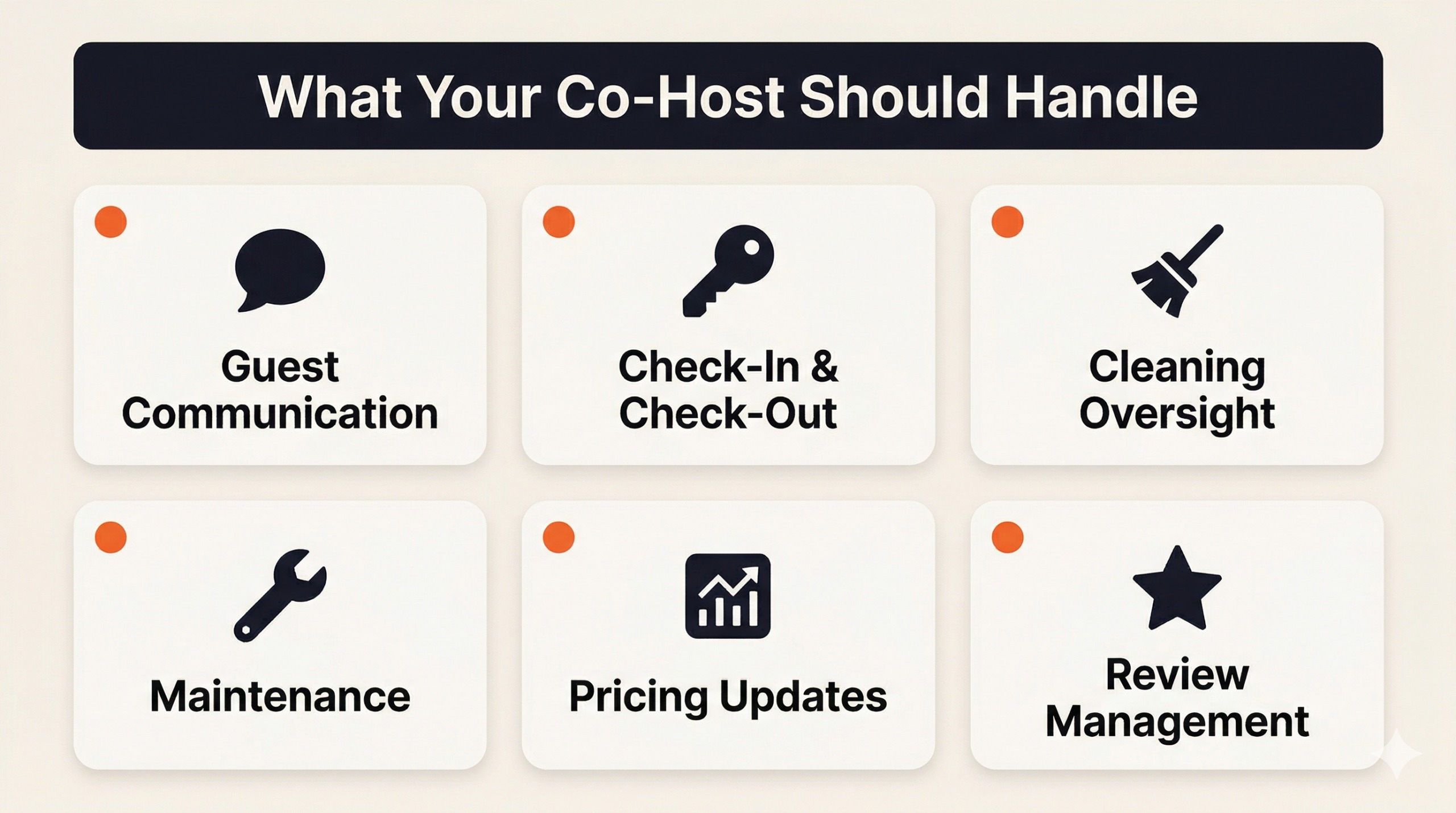
What a Good Co-Host Should Handle
- Guest communication. Responding to all pre-booking enquiries, booking confirmations, check-in instructions, and mid-stay messages — within one hour where possible. Airbnb’s algorithm penalises slow response rates, and this directly affects your listing’s visibility.
- Check-in and check-out coordination. Meeting guests on arrival, showing them the property, handling key handover, and conducting the check-out inspection. In Nairobi, this often means being available at unpredictable times, including evenings and weekends.
- Cleaning oversight. Coordinating with your cleaning team to ensure the property is turned over between bookings to a consistent standard. The co-host does not necessarily clean the property themselves — they manage the process.
- Minor maintenance. Handling small, immediate issues — a broken appliance, a Wi-Fi problem, a missing item — without needing to escalate everything to the property owner. This requires initiative and local contacts.
- Pricing updates. Adjusting nightly rates for peak periods, long weekends, and events in consultation with the primary host. An engaged co-host who monitors the market can meaningfully increase your monthly income.
- Review management. Writing thoughtful responses to guest reviews on your behalf. Both positive and negative reviews deserve a response — this signals to future guests that the listing is actively managed.
What a Co-Host Should Not Do Without Explicit Permission
- Change the listing price without discussion
- Accept long-term bookings outside your agreed minimum stay
- Make significant changes to the listing photos or description
- Sublet the property to guests outside the Airbnb platform
- Represent themselves as the property owner to guests or local authorities
Would you rather have a Kenyan team handle all of this for you — guest communication, check-ins, cleaning, reviews — with M-Pesa payouts and no foreign fees? See How Trubay Stayz Works →
What Co-Hosting Costs: Typical Rates in the Kenyan Market
Co-host fees in Kenya are not standardised, and many arrangements begin with an informal verbal agreement — which is a risk we will address shortly. That said, market rates for co-hosting services in Nairobi and along the Kenyan coast in 2026 generally follow this structure.
| Service Level | What’s Included | Typical Fee | Best For |
|---|---|---|---|
| Basic Co-Host | Guest messaging only. No physical presence required. | 8–12% of bookings | Owners who can handle check-ins but need messaging support |
| Standard Co-Host | Guest messaging + check-in/check-out + cleaning coordination | 15–20% of bookings | Most Kenyan hosts — the typical working arrangement |
| Full Management | Everything above + pricing, maintenance, listing updates, emergency response | 20–30% of bookings | Diaspora owners or multi-property hosts wanting full hands-off income |
| Trubay Stayz Platform | Full local management + M-Pesa payouts + KES pricing + dedicated host support | Competitive local rates | Hosts wanting a fully managed Kenya-specific solution with no currency losses |
When evaluating co-host fees, the percentage matters less than what it actually buys. A co-host charging 15% who responds to guests within 30 minutes, handles check-ins reliably, and keeps your rating above 4.8 stars is worth far more than one charging 10% who responds slowly and produces mediocre reviews. In Kenya’s short-stay market, your Airbnb rating directly determines your visibility — and your income.
Finding the Right Airbnb Co-Host in Kenya
The real advantage of Airbnb co-hosting in Kenya lies in having someone local, reliable, and genuinely invested in how your property performs. Unfortunately, finding this person is not as simple as posting a request online. The Kenyan co-hosting market is informal, unregulated, and — in some cases — unreliable. Here is where most successful host-co-host relationships actually begin.
01
Airbnb’s “Find a Co-Host” Feature
Airbnb has a co-host discovery feature, but its coverage in Kenya remains limited. It is worth checking, but do not rely on it as your primary search method. It works better in markets with dense Airbnb host communities.
02
Kenya Airbnb Host Communities
Facebook groups such as Kenya Airbnb Community and Nairobi Property Owners are active and genuinely useful. Post a clear description of what you need — location, property type, services required — and you will receive responses from people with real hosting experience.
03
Host Referrals
The most reliable co-hosts in Kenya are found through referrals from other hosts. If you know anyone who operates a short-stay property in your area, ask who manages theirs. A recommendation from a trusted host carries far more weight than any online profile.
04
Property Management Companies
Several Nairobi-based property management companies offer co-hosting as a service. These tend to be more structured and reliable than individual co-hosts, but usually charge at the higher end of the fee range. They are worth considering for multi-property owners.
05
Trubay Stayz
Rather than managing a co-hosting relationship yourself, listing on Trubay Stayz gives you a local Kenyan team that already handles what a co-host does — with M-Pesa payouts, local guest support, and a platform built specifically for this market.
06
What to Check Before You Agree
Always ask for references from current or previous hosts they work with. Visit their other managed properties if possible. Confirm they have reliable transport to reach your property quickly. Test their response time by messaging them at different hours before committing.
What Your Co-Hosting Agreement Must Include
Most co-hosting arrangements in Kenya begin with a handshake and a WhatsApp conversation. This is understandable — trust is built informally, and formalising an agreement feels unnecessary when things are going well. However, the moment something goes wrong — a missing payment, a guest complaint, a disagreement about responsibilities — the absence of a written agreement becomes a serious problem.
Your co-hosting agreement does not need to be a lawyer-drafted document. It does need to be written, agreed upon by both parties, and specific enough to resolve disputes without ambiguity. At minimum, it should cover these elements.
📋 Co-Hosting Agreement — Minimum Requirements
- Full names and contact details of both the primary host and the co-host
- The property address and Airbnb listing URL that the agreement covers
- A specific list of services the co-host is responsible for — use the checklist in Section 3
- The co-host’s fee — stated as a percentage of booking revenue or a flat monthly rate
- Payment timing — when and how the co-host will be paid after each booking (M-Pesa or bank)
- Response time expectations — for example, guest messages within 60 minutes, maintenance within 4 hours
- What constitutes a reason for either party to terminate the arrangement — and how much notice is required
- Who is responsible for cleaning costs — whether deducted from gross income or paid separately
- Confidentiality — the co-host should not share guest data, listing revenue, or property details with third parties
- Signatures and date — even a WhatsApp message with “I agree to the above terms” from both parties creates a record
⚠️ Tax Note
A co-host’s earnings are also taxable in Kenya. Co-hosting fees are classified as service income rather than rental income, which means the KRA treatment may differ from the Monthly Rental Income tax. If your co-host is earning consistently above KES 12,000 per month from co-hosting fees, they should verify their tax position with KRA or a registered tax agent. For your own tax obligations as the primary host, see our complete guide to short-term rental tax in Kenya.
Want to understand what your property can realistically earn before deciding whether co-hosting makes financial sense for you? See the Kenya Earnings Guide →
When Co-Hosting Is Not Enough — A Better Alternative
Co-hosting solves a specific problem: it gives you a local person to handle the day-to-day management of your Airbnb listing. For many property owners, this is exactly what they need. However, co-hosting has limitations that become more significant as your portfolio grows or as the market becomes more competitive.
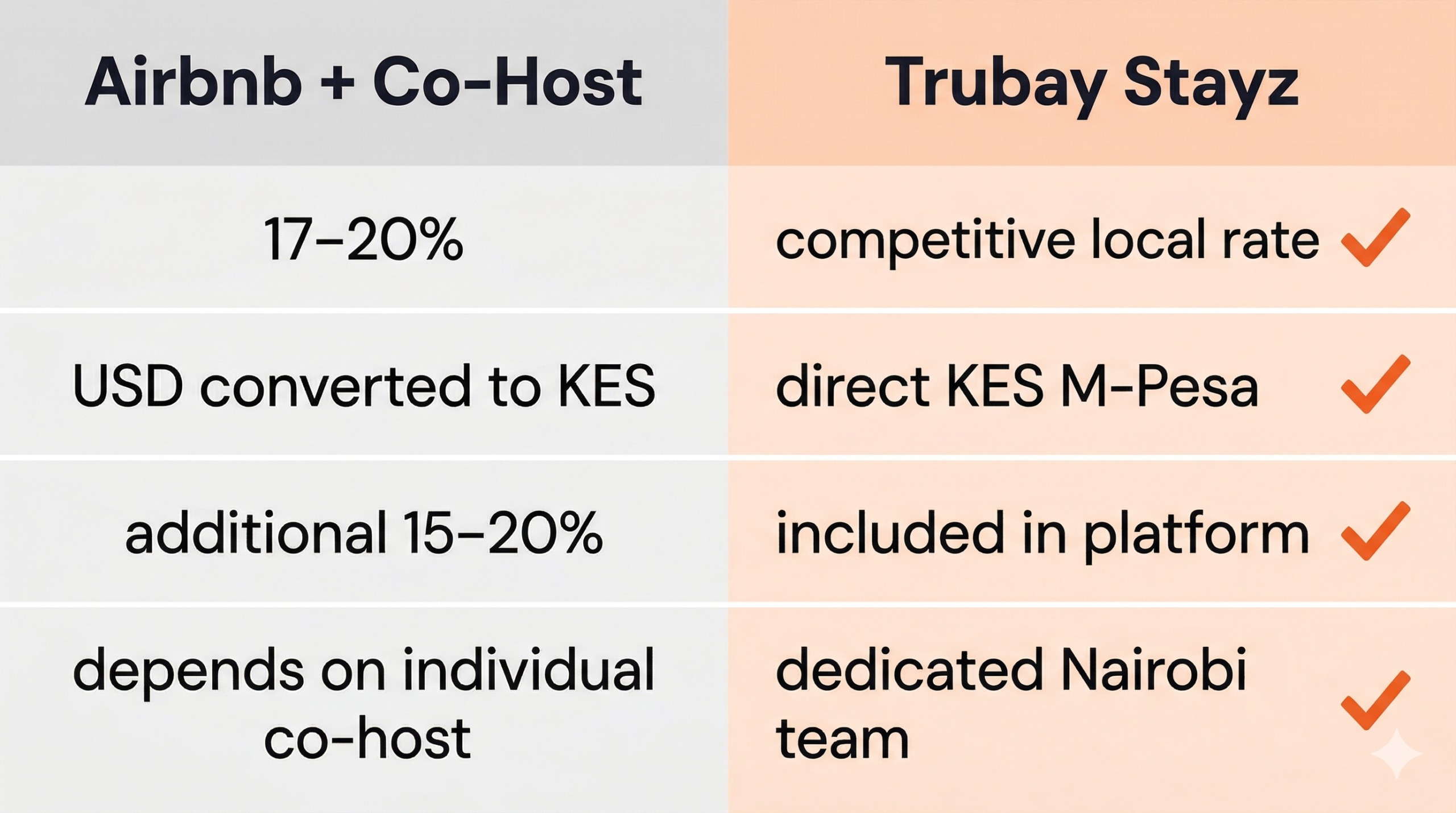
First, co-hosting does not solve the platform fee problem. Airbnb charges hosts and guests combined fees of 17–20% per booking. These fees are deducted before your co-host even begins earning their percentage. A property earning KES 5,000 per night on Airbnb may net the primary host as little as KES 3,300 after Airbnb fees and co-host fees are both deducted. Additionally, Airbnb pays out in USD converted to KES — meaning exchange rate losses on every transaction.
Second, co-hosting on Airbnb keeps your listing dependent on Airbnb’s algorithm, policies, and fee structure. If Airbnb changes its terms — as it does regularly — your co-host arrangement does nothing to protect you from the impact on your income.
This is why a growing number of Kenyan property owners are choosing to list on Trubay Stayz instead of — or in addition to — Airbnb. Trubay Stayz is a Kenyan platform built specifically for this market. Payouts are processed directly in KES via M-Pesa, eliminating currency conversion losses. Our local team handles the operational demands that a co-host would otherwise manage — guest support, booking management, and host guidance — without the additional layer of fees that co-hosting adds on top of Airbnb’s existing charges.
For a direct comparison of what Kenyan hosts earn on Airbnb versus local platforms, our guide to Airbnb alternatives in Kenya covers the numbers in full. The difference, calculated over a full year, is significant enough to reconsider where your primary listing lives.
Your property. Your income. Our local team is handling the rest — without Airbnb’s fees, currency conversions, or co-host percentages on top. List on Trubay Stayz Today →
Stop Managing. Start Earning.
Join Kenyan property owners who have moved beyond co-hosting to a fully local solution — M-Pesa payouts, real host support, and a platform built for Kenya’s market. Become a Host on Trubay Stayz →
Airbnb co-hosting in Kenya is an arrangement where a property owner invites a trusted local person — the co-host — to help manage their Airbnb listing. The co-host handles guest communication, check-ins, cleaning coordination, and maintenance on the owner’s behalf. In return, the co-host earns between 10 and 25% of each booking’s revenue, depending on the level of service provided. The primary host sets up the arrangement directly through Airbnb by navigating to their listing settings and inviting the co-host via email.
Airbnb co-host fees in Kenya typically range from 10 to 25% of booking revenue, depending on the services provided. A basic arrangement covering guest messaging only usually costs 8–12%. A standard co-hosting package, including messaging, check-ins, and cleaning oversight, typically costs 15–20%. Full property management, where the co-host handles everything, including pricing and maintenance, costs 20–30% of bookings.
The most reliable way to find an Airbnb co-host in Nairobi is through referrals from other short-stay property owners in your neighbourhood. Facebook groups such as Kenya Airbnb Community and Nairobi Property Owners are also useful sources. Airbnb’s own co-host discovery feature has limited coverage in Kenya. Always ask for references from current hosts they work with before agreeing to an arrangement, and confirm their response time and availability before committing.
Yes. A written co-hosting agreement is strongly recommended, even if the arrangement begins informally. The agreement should specify the co-host’s responsibilities, their fee and payment timing, expected response times, and termination conditions. In Kenya, where co-hosting arrangements are largely informal and unregulated, a written record — even a detailed WhatsApp message confirmed by both parties — protects both the property owner and the co-host if a dispute arises.
Yes. Co-hosting is one of the most practical solutions for diaspora Kenyans who own property in Nairobi, Mombasa, Diani, or other locations and cannot manage it in person. A reliable local co-host — or listing on a platform like Trubay Stayz — allows diaspora property owners to earn short-term rental income in KES via M-Pesa while living abroad, without needing to be physically present for day-to-day operations.
Co-hosting on Airbnb is an informal arrangement where one person assists another with managing their Airbnb listing, typically paid as a percentage of bookings. Property management is a broader, often more formalised service that may include managing the property across multiple platforms, handling legal compliance, coordinating major maintenance, and taking full operational responsibility for the property. Platforms like Trubay Stayz offer a hybrid approach — local management with a platform-based structure, M-Pesa payouts, and dedicated host support.
