

Vacation Rental Pricing Nairobi: The Complete 2026 Host Guide



By Oscar Murimi · Short-Term Rental Specialist, Trubay Stayz
Updated: March 2026 ⏱ 9 min read.
📌 Quick Answer
Vacation rental pricing in Nairobi typically ranges from KES 2,500 to KES 8,000 per night for a studio or one-bedroom apartment, and KES 5,500 to KES 15,000 per night for two-bedroom and larger units. The right nightly rate depends on your neighbourhood, property quality, current occupancy, and the season. Westlands and Kilimani command the highest consistent nightly rates in the city.
Table of Contents
- Why pricing is your most powerful host decision
- The four factors that determine your nightly rate
- Vacation rental pricing in Nairobi by neighbourhood (2026)
- Seasonal pricing: when to charge more
- Dynamic pricing — the strategy top hosts use
- Common pricing mistakes that cost Kenyan hosts money
- How to set your opening price if you are new
- How Trubay Stayz supports your pricing strategy
Vacation rental pricing in Nairobi is one of the most common questions we receive from property owners joining Trubay Stayz. Set your price too high and your calendar stays empty. Set it too low and you leave significant income on the table every single month. Getting this right — consistently — is the difference between a vacation rental that pays for itself and one that actually builds wealth.
This guide gives you a complete, current framework for pricing your Nairobi vacation rental in 2026. It covers neighbourhood benchmarks, seasonal adjustments, dynamic pricing principles, and the exact formula that experienced hosts on Trubay Stayz use to maintain strong occupancy without undervaluing their property.
Why Pricing Is Your Most Powerful Host Decision
Among all the decisions a host makes — furnishing, photography, listing description, guest communication — pricing has the single greatest impact on monthly income. A ten percent increase in your nightly rate at the same occupancy level directly increases your monthly earnings by ten percent. But a poorly timed price increase that drops occupancy from 70% to 50% can cut monthly income by nearly 30%.
This is why pricing is a strategy, not a one-time decision. Hosts who review and adjust their rates monthly — responding to season, demand, local events, and competitor listings — consistently out-earn hosts who set a price once and forget it. The good news is that in Nairobi’s short-stay market, the data you need to price well is available and readable once you know where to look.
The Four Factors That Determine Your Nightly Rate
Before looking at specific figures for Nairobi neighbourhoods, it is important to understand the framework behind any good pricing decision. Four variables drive your optimal nightly rate.
1. Location and Neighbourhood
Your neighbourhood sets the ceiling of what guests in Nairobi will pay. Westlands, Kilimani, and Lavington attract guests who are willing to pay a premium for proximity to business hubs, restaurants, and transport. Properties in Roysambu, South B, or Kahawa West serve a different guest segment at a lower price point — but with potentially higher occupancy if priced correctly for that market.
2. Property Type and Quality
A fully furnished, professionally photographed studio with fast Wi-Fi and quality linen commands a premium over a basic unit in the same building. Guests on short stays are paying for comfort and confidence. Every amenity you add — smart TV, well-stocked kitchen, blackout curtains, secure parking — justifies a higher rate and improves your review scores, which then sustains that higher rate over time.
3. Market Demand and Seasonality
Nairobi has distinct demand patterns throughout the year. Business travel remains fairly consistent, but leisure travel peaks around school holidays, long weekends, and major events. Understanding when demand in your neighbourhood surges allows you to raise rates during those windows — sometimes by 20 to 40% — without losing occupancy.
4. Competitive Positioning
Your price does not exist in isolation. Guests comparing options on any platform will see your listing alongside similar properties. Knowing what comparable properties in your neighbourhood charge — and understanding why they are priced that way — helps you position your listing competitively without defaulting to the lowest price in the market.
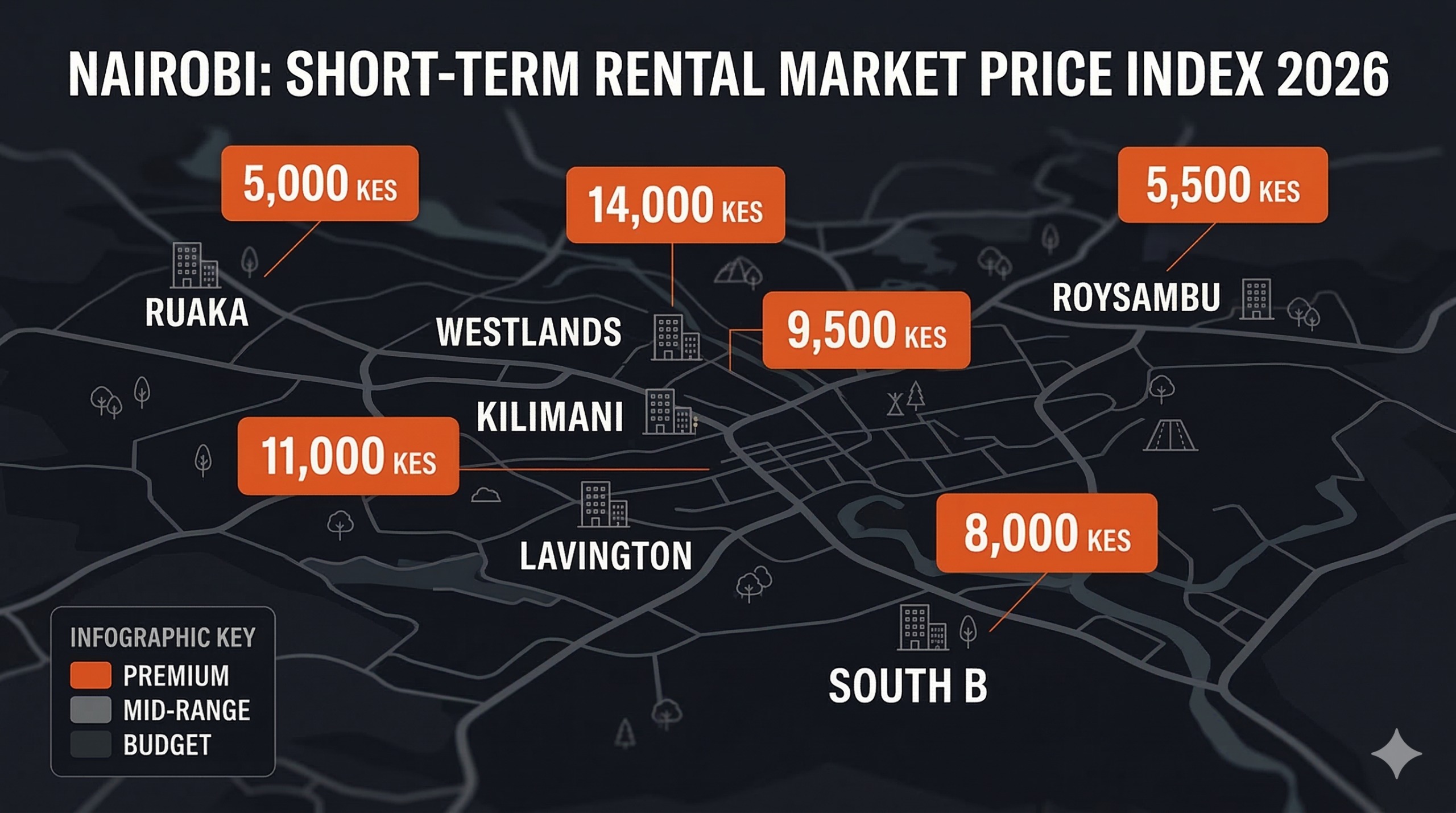
A clean, modern illustrated map of Nairobi showing key short-term rental neighbourhoods — Westlands, Kilimani, Lavington, South B, Ruaka, Roysambu — each labeled with a floating price card showing nightly KES rates. The design should feel data-driven and editorial, like an infographic from a premium Kenyan property magazine. Brand colors: deep orange (#F0622A) for highlights, dark charcoal (#141420) for map base, and white labels. Clean sans-serif typography. No photographs, pure vector illustration style. 16:9 ratio.
Vacation Rental Pricing in Nairobi by Neighbourhood (2026)
The following table shows current nightly rate benchmarks for Nairobi’s major short-stay neighbourhoods. These figures reflect actively managed listings on platforms, including Trubay Stayz, and reflect 2026 market conditions. Understanding vacation rental pricing in Nairobi across these areas gives you a clear starting anchor for your own listing.
| Neighbourhood | Studio | 1-Bedroom | 2-Bedroom | Demand Level |
|---|---|---|---|---|
| Westlands | KES 3,500–4,800 | KES 4,500–6,500 | KES 7,000–12,000 | Very High |
| Kilimani | KES 2,800–4,200 | KES 4,000–6,000 | KES 6,500–11,000 | Very High |
| Lavington | KES 3,200–5,000 | KES 5,000–7,500 | KES 8,000–14,000 | High |
| Ruaka / Gigiri | KES 2,500–3,800 | KES 3,500–5,500 | KES 5,000–9,000 | High |
| South B / South C | KES 2,200–3,200 | KES 3,000–4,500 | KES 4,500–7,500 | Medium–High |
| Roysambu | KES 2,000–2,800 | KES 2,500–3,800 | KES 3,500–6,000 | Medium |
| Parklands | KES 3,000–4,500 | KES 4,000–6,500 | KES 6,000–10,000 | High |
Seasonal Pricing: When to Charge More in Nairobi
Nairobi’s rental demand follows a clear seasonal pattern. Business travel creates a reliable base throughout the year, but leisure demand — which makes up an increasing share of Trubay Stayz bookings — peaks predictably during the following windows.
- December–January: The strongest demand window of the year. Diaspora visitors returning to Kenya, family travel, and end-of-year corporate events all converge. Raise rates by 25–40% above your standard price during this window.
- July–August: School holiday season for both Kenyan families and international visitors. Long-stay bookings increase. Raise rates by 15–25% and prioritise longer bookings over single nights.
- Easter & public holiday weekends: Three and four-night minimum stays become achievable. Raise nightly rates by 15–20% and consider implementing a minimum night stay of 2–3 nights.
- Major Nairobi events: International conferences, Nairobi Marathon, and large concerts create short, sharp demand spikes. Monitor the Nairobi events calendar and adjust rates for those specific dates.
Dynamic Pricing — The Strategy Top Hosts Use
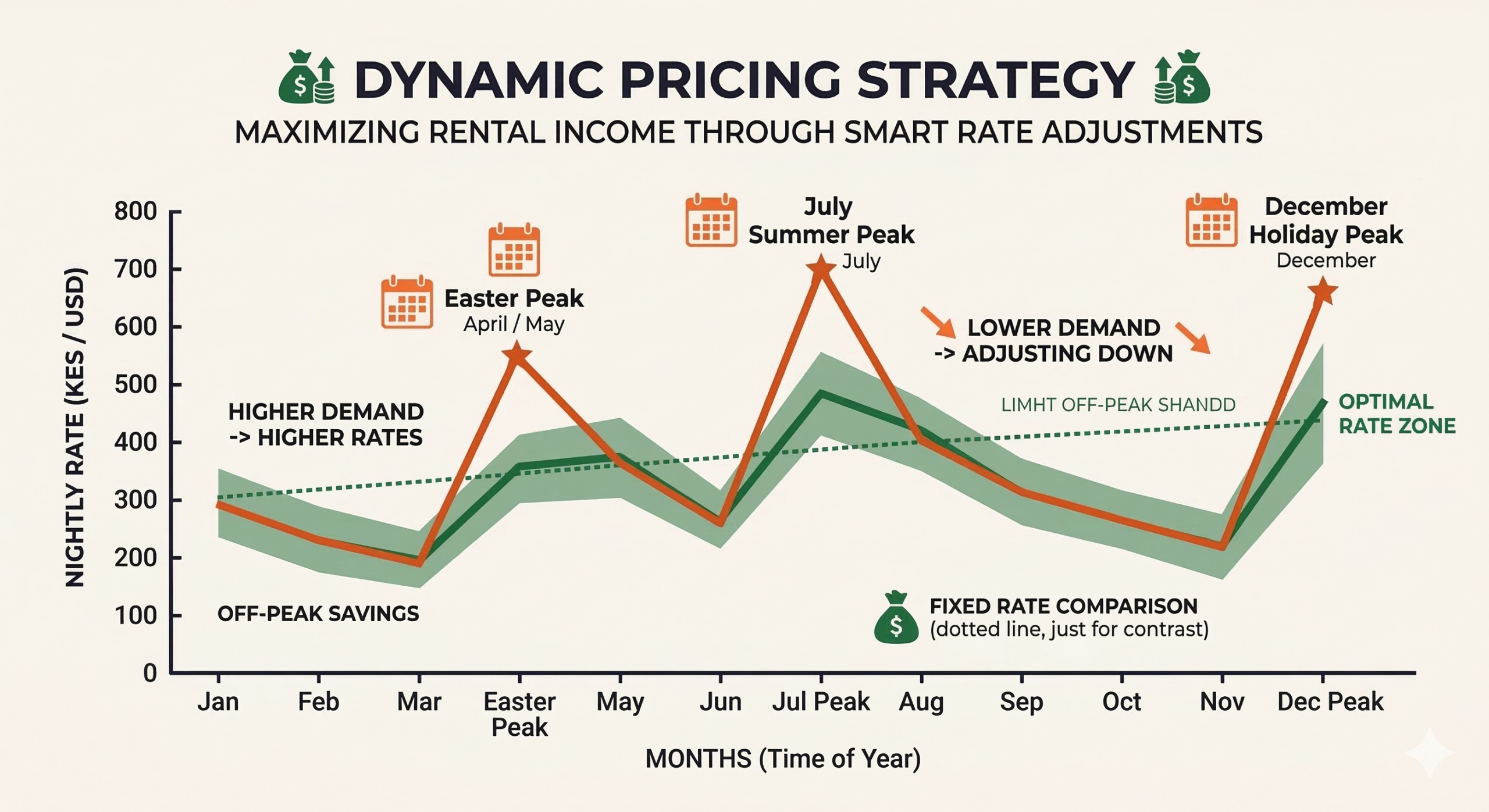
Dynamic pricing means adjusting your nightly rate based on real-time demand, rather than setting a fixed price and leaving it unchanged for months. It is the approach that separates hosts earning KES 60,000 per month from those earning KES 95,000 — with the same property.
The principle is straightforward. When your calendar has many empty nights in the near future, lower your rate to attract bookings and maintain occupancy. When your calendar is filling up and demand is strong, raise your rate because guests who really want your dates will still book. This responsive approach maximises both occupancy and revenue simultaneously.
A practical starting point: check your calendar every Monday morning. If you have fewer than 40% of the coming month’s nights booked, your rate may be too high for current demand. If you are consistently above 80% booked, your rate is likely too low — you are leaving money behind on every booking you take.
Common Pricing Mistakes That Cost Kenyan Hosts Money
- Setting and forgetting. Leaving the same rate unchanged for months ignores seasonal demand entirely. Every host should review rates at least monthly.
- Pricing below cost. Some new hosts undercharge to get their first bookings — and then discover they are barely covering cleaning costs. Know your break-even nightly rate before setting any price.
- Not accounting for platform fees. If your target take-home rate is KES 4,000 per night, your listed rate needs to account for platform fees on top of that. Factor this into your pricing from the start.
- Ignoring competitor listings. A 2-bedroom apartment in Kilimani priced at KES 14,000 per night in a market where comparable properties list at KES 9,000 will not book — regardless of how good the photos are.
- Uniform weekday and weekend pricing. Weekend demand in Nairobi is stronger than weekday demand for leisure travel. A small weekend premium of 15–20% captures this value without requiring any extra effort.
How to Set Your Opening Price as a New Nairobi Host
If you are listing your property for the first time, your opening price strategy is different from your long-term pricing strategy. New listings have no reviews, which means guests have no social proof to rely on when deciding to book. This makes them more price-sensitive than guests choosing between two established listings.
The recommended approach for new listings is to enter the market at 10–15% below the median rate for comparable properties in your neighbourhood. This makes you a compelling value option among guests browsing similar listings. As bookings arrive and reviews accumulate, raise your rate incrementally — by KES 200–500 per night every two to four weeks — until you reach or slightly exceed the market median for your property type.
Most Trubay Stayz hosts reach competitive market pricing within 60–90 days of their first listing, with enough reviews to sustain it. The short-term sacrifice in rate during the launch period typically pays back within the first quarter of active hosting.
How Trubay Stayz Supports Your Pricing Strategy
Pricing well requires current, local market data — and that is one of the core advantages of listing on Trubay Stayz. As Kenya’s dedicated short-stay platform, we have direct visibility into real booking patterns across Nairobi, Mombasa, Diani, Naivasha, and Nakuru. Our host onboarding process includes a pricing consultation based on your specific neighbourhood and property type, so you launch with a rate grounded in current market reality — not guesswork.
Additionally, payouts on Trubay Stayz are processed directly in Kenyan Shillings via M-Pesa, which means your stated rate is your actual take-home rate — no currency conversion losses, no foreign exchange surprises. For a full picture of what your property can earn, read our complete guide to short-term rental income in Kenya, and for the legal framework every host needs to understand, see our Kenya short-term rental laws guide.
List Your Property. Set the Right Price. Start Earning.
Join Kenyan hosts earning consistent short-term rental income on Trubay Stayz — with local M-Pesa payouts and real pricing guidance from our team. Become a Host on Trubay Stayz →
Vacation rental pricing in Nairobi ranges from KES 2,000 to KES 15,000+ per night, depending on neighbourhood, property size, and season. A studio in Kilimani averages KES 2,800–4,200 per night, while a two-bedroom in Westlands averages KES 7,000–12,000 per night. Well-managed listings in prime locations consistently achieve the higher end of these ranges.
To price your Nairobi vacation rental competitively, start by searching for listings similar to yours in your specific neighbourhood and note the median nightly rate. If you are new with no reviews, price 10–15% below that median initially, then increase your rate by KES 200–500 every 3–4 weeks as bookings and reviews accumulate.
The best times to increase your Nairobi vacation rental rates are December to January (peak demand, raise by 25–40%), July to August (school holidays, raise by 15–25%), and during major Nairobi events and long public holiday weekends. Adjust rates back to standard levels once these peak periods pass.
Dynamic pricing means adjusting your nightly rate based on real-time demand rather than using a single fixed price. It works well in Nairobi because the market has clear seasonal patterns and demand variation between weekdays and weekends. Hosts who review and adjust rates weekly or bi-weekly consistently earn 15–25% more annually than those using fixed pricing.
Lavington and Westlands consistently command the highest vacation rental nightly rates in Nairobi, followed closely by Kilimani and Parklands. These neighbourhoods attract both high-value leisure guests and corporate travellers, supporting premium pricing year-round.
